

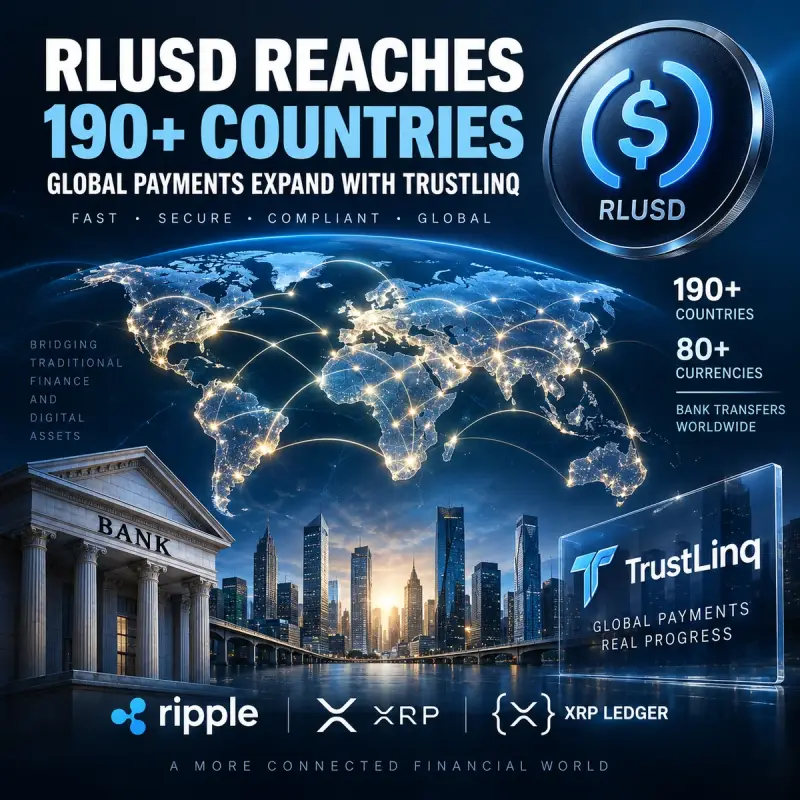
Ripple USD (RLUSD) is expanding its international reach significantly.
Through TrustLinq, the stablecoin can now support payment routes across more than 190 countries and over 80 currencies, bringing RLUSD further into the area of cross-border payments and global digital financial infrastructure.
The development is especially notable because RLUSD has already gained institutional relevance through custody services, trading integrations and broader use within Ripple’s financial ecosystem.
However, geographic reach alone does not automatically mean real adoption.
What matters is whether RLUSD is actually used in real payment flows and whether that activity creates measurable transaction volume across blockchain-based infrastructure such as the XRP Ledger.
For XRP holders, one question is especially important:
Could the global expansion of RLUSD eventually strengthen demand for XRP — or can the stablecoin grow largely independently from the native asset of the XRP Ledger?
Why Is RLUSD’s Global Reach Relevant?
For a stablecoin, market capitalization is not the only important factor.
It also matters where and how the asset can actually be used.
If RLUSD can support payment routes across more than 190 countries and multiple currency zones, its potential use cases expand significantly.
This could be particularly relevant for:
- international business payments
- cross-border settlement
- institutional liquidity
- payments between different currency regions
- digital treasury operations
- blockchain-based payment infrastructure
That could move RLUSD closer to becoming a practical tool for companies and financial institutions that need a stable digital U.S. dollar for international transactions.
However, one distinction remains important:
Global reach is not the same as real-world usage.
The true significance of this expansion will depend on whether RLUSD is actually used regularly in real payment flows.
Why Are Cross-Border Payments Especially Important for RLUSD?
Cross-border payments are one of the areas where stablecoins can offer particularly clear practical advantages.
Traditional international transfers often rely on multiple banks, correspondent banking networks and different currencies. This can lead to delays, additional fees and complex settlement processes.
A stablecoin such as RLUSD can potentially offer several advantages:
- faster digital settlement
- fewer intermediaries
- 24/7 availability
- easier transfer of a digital U.S. dollar value
- better integration into blockchain-based payment processes
The real test will be whether RLUSD moves beyond crypto exchanges and becomes part of actual international payment flows.
That is where the difference lies between being simply another stablecoin and becoming a meaningful component of global payment infrastructure.
What Role Does the XRP Ledger Play?
RLUSD can be used on the XRP Ledger. That makes the question especially interesting whether the stablecoin’s growing international reach will also lead to more activity on XRPL.
For cross-border payments, the XRP Ledger can offer several relevant characteristics:
- fast settlement
- low transaction costs
- 24/7 availability
- support for digital assets
- direct stablecoin integration
- potential use in institutional payment and settlement processes
If RLUSD is increasingly used for real international payments, the XRP Ledger could gain further importance as payment infrastructure.
However, one distinction remains essential:
More RLUSD activity on the XRP Ledger does not automatically create more demand for XRP.
RLUSD can move on XRPL without XRP being used as a bridge asset in every transaction. What matters is whether additional XRP-based liquidity and settlement use cases develop alongside the stablecoin.
What Does RLUSD’s Expansion Mean for XRP?
For XRP holders, it is important to distinguish between growth in RLUSD usage and direct demand for XRP.
If RLUSD is used more frequently for international payments, the first direct effect is stronger adoption of the stablecoin itself and of the infrastructure used to move it.
XRP could benefit more directly if additional use cases emerge in which XRP is used as:
- a bridge asset between currencies or digital assets
- a liquidity tool for international payment flows
- part of institutional settlement processes
- the native asset within XRPL-based financial applications
That means the global expansion of RLUSD is not automatically a direct price catalyst for XRP.
However, it could help bring the broader XRP Ledger ecosystem deeper into real international financial activity.
The key question is whether RLUSD and XRP continue to grow side by side, or whether more applications emerge in which both assets are functionally connected.
Why Real Usage Matters More Than Geographic Reach
More than 190 countries sounds impressive, but the long-term importance of RLUSD will depend on how actively that reach is actually used.
The most important indicators will include:
- real transaction volume
- the number of active payment routes
- usage by companies and financial institutions
- recurring settlement activity
- liquidity on the XRP Ledger
- integration into real treasury and payment workflows
Only when those metrics begin to grow can we judge whether RLUSD is becoming a meaningful part of global payment infrastructure.
For the XRP ecosystem, that is the key point:
Not just wider availability, but more real financial activity on the XRP Ledger.
How Does This Fit Into the Institutional Development of RLUSD and XRPL?
The TrustLinq expansion fits into a broader trend.
RLUSD is increasingly being positioned not only as a stablecoin for the crypto market, but as a potential component of institutional financial infrastructure.
This includes:
- regulated custody through banks
- potential use as collateral in institutional trading
- cross-border payments
- digital treasury processes
- blockchain-based settlement
- links between traditional finance and digital assets
The expansion through TrustLinq therefore complements other recent developments around RLUSD and the XRP Ledger.
For XRPL, this is relevant because more and more use cases are beginning to converge around stablecoins, tokenization, payments and settlement.
Over time, these developments could help create a broader institutional financial ecosystem around the XRP Ledger.
For a broader overview of these developments, see our XRP Ledger Institutional Finance Map 2026.
Standard Chartered’s institutional custody support for RLUSD also shows how the stablecoin is moving deeper into regulated financial infrastructure.
At the same time, features such as Permission Delegation are making the XRP Ledger more suitable for complex institutional roles and access structures.
BatchV1_1 complements this development by enabling more coordinated transaction workflows for payments and settlement.
Learn More About XRP, Ripple and the Future of Digital Finance
If you want to understand the bigger picture behind XRP, Ripple, the XRP Ledger, RLUSD, stablecoins and global payment infrastructure, my book “XRP – WHEN THE GIANT AWAKENS” provides a much deeper overview.
The book explains not only the XRP ecosystem, but also the foundations of today’s financial system — from banks, money creation and inflation to blockchain, stablecoins, tokenization and the possible future of international financial flows.
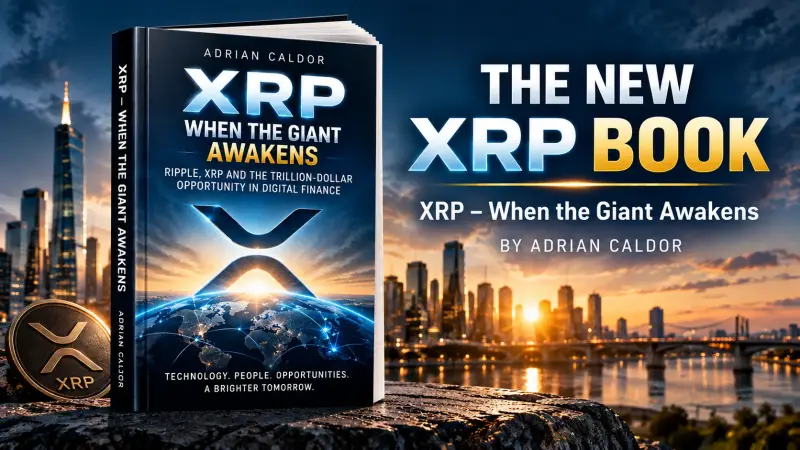
XRP – WHEN THE GIANT AWAKENS
Ripple, XRP and the Trillion-Dollar Opportunity in Digital Finance
by Adrian Caldor
Conclusion
The expansion of RLUSD across more than 190 countries and multiple currency zones is an important step for the stablecoin’s international reach.
The focus on cross-border payments is especially relevant because it moves RLUSD beyond simple exchange-based usage and closer to real global payment infrastructure.
For RLUSD, this could create more practical use cases in international business payments, treasury operations and settlement.
For the XRP Ledger, broader RLUSD usage could increase activity and strengthen its role as blockchain infrastructure for digital finance.
For XRP itself, however, one distinction remains important:
More RLUSD reach does not automatically mean more XRP demand.
What matters is whether real payment flows, liquidity use cases and settlement processes emerge in which RLUSD, XRP and the XRP Ledger become functionally connected.
Only then would global availability translate into deeper economic significance for the broader XRP ecosystem.
Sources
-
TrustLinq – Pay with RLUSD: Bank Transfers to 190+ Countries
Offizielle Quelle zur RLUSD-Erweiterung, Bankzahlungen in mehr als 190 Ländern und Unterstützung zahlreicher Währungen.
Open source -
TrustLinq – About / Payment Infrastructure
Offizielle Angaben zur internationalen Reichweite, unterstützten Währungen und Zahlungskorridoren.
Open source -
Chainwire – TrustLinq Expands Ripple Partnership
Meldung zur erweiterten Ripple-/TrustLinq-Zusammenarbeit und globalen RLUSD-Zahlungsinfrastruktur.
Open source
Add comment
Comments