

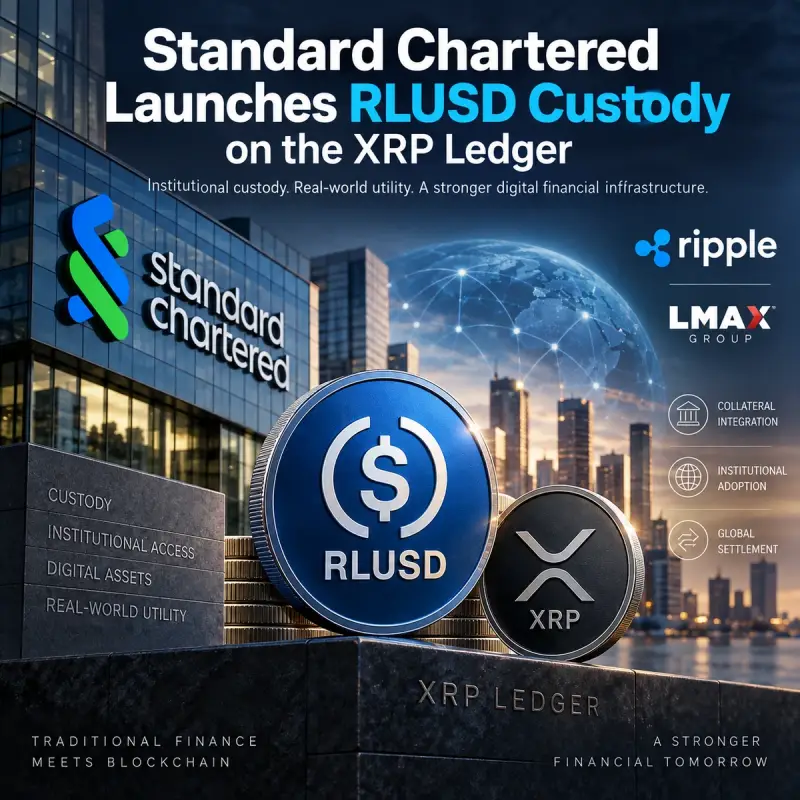
Standard Chartered is now supporting institutional custody for Ripple USD (RLUSD) on the XRP Ledger.
Eligible institutional clients can access regulated banking infrastructure for the custody of the stablecoin through Standard Chartered’s DIFC branch, which is regulated by the Dubai Financial Services Authority.
At the same time, Standard Chartered is working with Ripple and LMAX Group on a planned integration that could allow RLUSD to be used as eligible collateral in certain institutional trading environments.
For the XRP ecosystem, this is particularly significant because several institutional components are coming together:
- RLUSD as a regulated stablecoin
- the XRP Ledger as blockchain infrastructure
- Standard Chartered as a global bank
- LMAX Group as an institutional trading venue
- Ripple as a provider of stablecoin and financial infrastructure
The key question is therefore:
Could RLUSD become a meaningful institutional building block for trading, collateral and digital finance on the XRP Ledger?
Why Is Standard Chartered’s RLUSD Custody Important?
For institutional investors, secure custody is a basic requirement when dealing with digital assets.
Large banks, funds and professional investors cannot simply hold stablecoins in the same way as retail users. They need regulated processes, clear responsibilities and infrastructure that can be integrated into existing compliance and risk-management systems.
This is where Standard Chartered becomes important.
By offering institutional custody for RLUSD on the XRP Ledger, the bank creates a direct connection between traditional banking infrastructure and blockchain-based finance.
For RLUSD, this could be especially relevant because it may:
- make institutional custody available through a global bank
- improve access for regulated market participants
- support deeper integration into professional financial processes
- increase confidence in the underlying infrastructure
This moves RLUSD further beyond being just a crypto-market stablecoin and closer to becoming a potential component of institutional finance.
What Role Does the XRP Ledger Play?
What makes this development particularly interesting is that RLUSD custody is being supported directly on the XRP Ledger.
That brings the XRP Ledger further into focus as infrastructure for institutional stablecoin use.
For banks and professional market participants, it is not enough for a stablecoin to simply exist. The underlying network also needs to support secure issuance, custody, transfer and settlement.
The XRP Ledger offers several features that can be relevant for institutional applications:
- fast transaction settlement
- low transaction costs
- support for tokenized assets
- stablecoin integration
- institutional payment and settlement use cases
Standard Chartered’s involvement therefore does more than increase the visibility of RLUSD. It also strengthens the XRP Ledger’s position as potential infrastructure for regulated digital finance.
One important distinction remains:
Custody of RLUSD on the XRP Ledger does not automatically mean that XRP itself is used in every related transaction.
RLUSD and XRP can exist within the same ecosystem while serving different functions.
Why Is the Planned Use of RLUSD as Collateral Important?
The planned integration of RLUSD as eligible collateral could be even more important than custody alone.
Collateral plays a central role in institutional finance. Banks, brokers and trading firms use collateral to secure positions, reduce counterparty risk and gain access to certain trading activities.
If RLUSD can be used in this way, the stablecoin could move deeper into traditional financial workflows.
Potential use cases could include:
- trading finance
- margin requirements
- collateral for institutional positions
- digital liquidity
- settlement between market participants
- connections between traditional and blockchain-based markets
The involvement of LMAX Group is especially notable because it suggests that RLUSD is being positioned not only as a payment instrument, but potentially as an institutional financial asset.
For the XRP Ledger, that would represent another step toward professional financial infrastructure.
What Does This Development Mean for XRP?
For XRP holders, it is important not to equate RLUSD adoption with direct XRP adoption.
If banks or institutional clients custody RLUSD or use it as collateral, that does not automatically create direct demand for XRP.
Still, the development can be relevant for the broader XRP ecosystem.
The more regulated financial institutions use the XRP Ledger for stablecoins, settlement or other digital finance processes, the more important the underlying infrastructure can become.
XRP could benefit more directly if it is increasingly used as:
- a bridge asset between currencies or digital assets
- a liquidity instrument within institutional payment flows
- part of settlement processes
- the native asset in XRPL-based financial applications
The key point is therefore:
More RLUSD usage does not automatically mean more XRP demand — but it can strengthen the institutional relevance of the XRP Ledger as a whole.
Why Is Standard Chartered Such an Important Partner?
Standard Chartered is not a small crypto company. It is a major international bank with a strong presence across Asia, the Middle East and other key financial markets.
That gives the RLUSD custody service more weight than support from a crypto-native platform alone.
For institutional market participants, an established bank can offer several advantages:
- regulated custody processes
- existing compliance frameworks
- institutional risk management
- established relationships within traditional finance
- easier integration into existing banking and trading systems
This can help reduce the gap between traditional finance and blockchain-based assets.
For Ripple, the cooperation is strategically important because RLUSD is being positioned not only within the crypto market, but increasingly within structures that are relevant to banks, brokers and professional investors.
For the XRP Ledger, it also increases visibility as infrastructure for regulated digital financial applications.
Ripple’s cooperation with Meritz Securities in South Korea also shows how institutional custody and tokenization are moving deeper into traditional finance.
How Does This Fit Into the XRP Ledger’s Institutional Development?
Standard Chartered’s RLUSD custody service is not an isolated development.
Over the past months, the XRP Ledger has increasingly been positioned for broader institutional use.
This includes:
- stablecoins such as RLUSD
- tokenized assets
- institutional custody solutions
- Permission Delegation for more granular access control
- BatchV1_1 for coordinated transaction workflows
- growing use cases around settlement and digital financial infrastructure
Standard Chartered’s involvement fits directly into this broader trend.
It shows that institutional adoption is not only about adding new technical features. Traditional financial institutions are also beginning to offer concrete services around assets and infrastructure connected to the XRP Ledger.
That matters because institutional adoption requires more than technology alone.
It also needs custody, liquidity, regulatory frameworks, banking access and real-world use cases.
These pieces are now beginning to come together more clearly.
For a broader overview of these developments, see our XRP Ledger Institutional Finance Map 2026.
Learn More About XRP, Ripple and the Future of Digital Finance
If you want to understand the bigger picture behind XRP, Ripple, the XRP Ledger, RLUSD, stablecoins and institutional financial infrastructure, my book “XRP – WHEN THE GIANT AWAKENS” provides a much deeper overview.
The book explains not only the XRP ecosystem, but also the foundations of today’s financial system — from banks, money creation and inflation to blockchain, stablecoins, tokenization and the possible future of international financial markets.
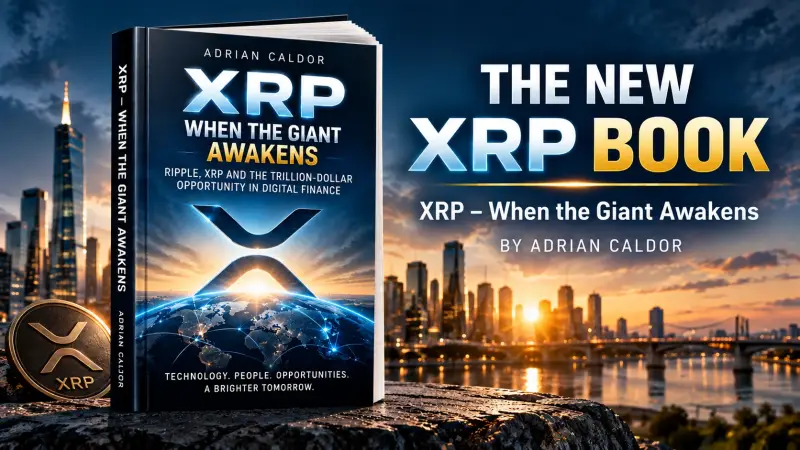
XRP – WHEN THE GIANT AWAKENS
Ripple, XRP and the Trillion-Dollar Opportunity in Digital Finance
by Adrian Caldor
Conclusion
Standard Chartered’s launch of RLUSD custody represents another important step toward institutional adoption of digital assets.
For RLUSD, the partnership is particularly relevant because it brings the stablecoin deeper into regulated banking and trading infrastructure.
For the XRP Ledger, the development shows that institutional adoption is no longer only about technical upgrades. Established financial institutions are increasingly beginning to offer concrete services built around XRPL-based assets and infrastructure.
For XRP itself, one distinction remains important:
More RLUSD usage does not automatically create more demand for XRP.
Over the long term, however, broader institutional use of the XRP Ledger could strengthen the entire ecosystem and create additional use cases.
The key question will be whether RLUSD, XRP and XRPL-based applications become increasingly integrated into institutional payment, collateral and settlement processes.
Sources
-
Standard Chartered – RLUSD Custody and Planned Collateral Integration
Offizielle Mitteilung zur institutionellen Verwahrung von RLUSD und zur geplanten Integration als Sicherheit mit Ripple und LMAX Group.
Open source -
Ripple – Standard Chartered Launches RLUSD Custody
Offizielle Ripple-Mitteilung zur RLUSD-Verwahrung auf dem XRP Ledger und zur geplanten Collateral-Nutzung.
Open source
Add comment
Comments