

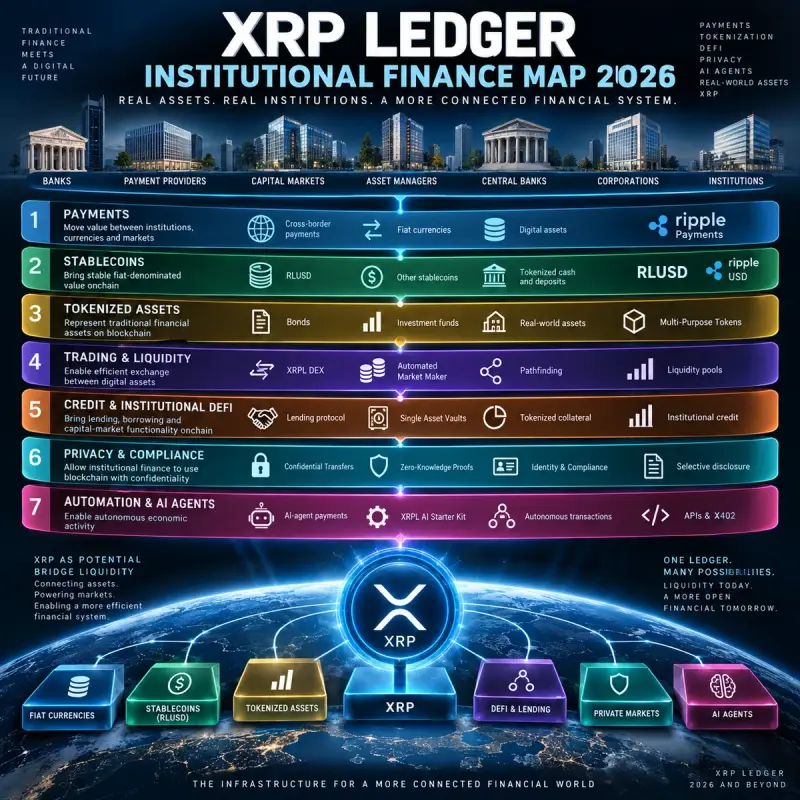
XRP Ledger Institutional Finance Map 2026
HOW RIPPLE, XRPL, RLUSD, TOKENIZATION, PRIVACY, AI AGENTS AND XRP COULD FIT INTO THE NEW FINANCIAL INFRASTRUCTURE
The XRP Ledger is no longer being discussed solely as infrastructure for fast digital payments.
Across payments, stablecoins, tokenization, real-world assets, institutional DeFi, privacy technology and AI-driven finance, a much broader financial ecosystem is beginning to emerge around Ripple, the XRP Ledger and XRP.
But these developments are often reported separately.
A new stablecoin launches. A financial institution experiments with tokenization. Privacy technology is proposed. AI agents begin making autonomous payments. Another institution explores blockchain-based settlement.
The bigger question is:
How could all of these pieces eventually fit together?
This 2026 overview maps the major components of the emerging XRP Ledger financial ecosystem – from Ripple Payments and RLUSD to tokenized assets, institutional liquidity, privacy, AI agents and the potential role of XRP itself.
The goal is not to predict the price of XRP or assume that every XRPL application will use XRP.
Instead, the goal is to understand the infrastructure: what is already operational, what is being developed, how the individual components connect – and where XRP could potentially provide functional value within that system.
1. THE FOUNDATION: XRP LEDGER AS FINANCIAL INFRASTRUCTURE
The XRP Ledger (XRPL) is a decentralized Layer-1 blockchain originally designed for fast and efficient value transfer. Since its launch in 2012, the network has operated continuously without relying on proof-of-work mining. Ripple describes XRPL as infrastructure built for payments, tokenization, decentralized exchange and institutional financial applications.
Its architecture differs from many smart-contract-focused blockchains. Several financial functions are built directly into the ledger itself, including a native decentralized exchange (DEX), issued currencies and tokens, escrow, payment channels and pathfinding for cross-currency payments.
This matters because institutional blockchain adoption requires more than simply transferring a cryptocurrency from one wallet to another.
A financial infrastructure may need to support:
Payments and settlement
Stablecoins and tokenized currencies
Tokenized real-world assets
Trading and liquidity
Compliance and identity
Institutional custody
Privacy
Automated financial applications
The XRP Ledger is increasingly being developed around these broader requirements.
Ripple’s institutional strategy also extends beyond XRPL itself. The company now operates across cross-border payments, digital-asset custody, stablecoins and tokenization, while continuing to support development of the XRP Ledger ecosystem.
This creates an important distinction that will apply throughout this map:
Ripple, the XRP Ledger and XRP are related – but they are not the same thing.
Ripple is a technology company.
The XRP Ledger is an open-source decentralized blockchain.
XRP is the native digital asset of the XRP Ledger.
Understanding those distinctions is essential. A Ripple product does not automatically require XRP. Likewise, an application built on XRPL does not necessarily create substantial XRP demand.
The more useful question is therefore:
Where does each component fit – and under what circumstances could XRP provide liquidity, settlement or bridge-asset functionality within the wider ecosystem?
That is the framework for the rest of this Institutional Finance Map.
2. RIPPLE PAYMENTS: CONNECTING TRADITIONAL FINANCE WITH DIGITAL ASSETS
One of the most established components of Ripple’s institutional infrastructure is Ripple Payments – the company’s cross-border payments platform for banks, payment providers and other financial institutions.
The fundamental problem it addresses is familiar: moving money internationally can still require multiple intermediaries, correspondent-bank relationships, prefunded accounts, foreign-exchange conversion and separate messaging and settlement processes.
Ripple Payments is designed to connect traditional financial infrastructure with digital-asset-based payment rails, allowing institutions to move value across borders without requiring every participant to build its own blockchain infrastructure.
An important point is that Ripple Payments should not simply be described as “XRP payments.”
Ripple’s infrastructure can support different settlement mechanisms depending on the payment corridor, regulatory environment and liquidity requirements. Digital assets can be used where appropriate, while fiat currencies and stablecoins can also form part of the payment flow.
This becomes particularly interesting with RLUSD, Ripple’s regulated US-dollar stablecoin. Ripple has integrated RLUSD into its payments infrastructure, giving institutional customers another digital settlement asset alongside existing payment and liquidity options.
WHERE COULD XRP FIT?
XRP can potentially function as a bridge asset when liquidity needs to move between two different currencies or assets.
Instead of maintaining direct liquidity between every possible currency pair, a bridge asset can theoretically provide an intermediate market:
Currency A → XRP → Currency B
This is fundamentally different from a stablecoin.
RLUSD is designed to maintain a value corresponding to the US dollar.
XRP is a freely traded digital asset whose potential utility comes partly from its ability to move value and provide liquidity between different assets and markets.
The two therefore do not necessarily have to compete.
In a broader digital financial infrastructure, they could serve different functions:
RLUSD → stable dollar-denominated value
XRP → potential bridge liquidity between assets and markets
Whether XRP is actually used in a particular payment flow depends on factors such as liquidity, cost, regulation, available trading pairs and the architecture chosen by the institution.
This distinction is critical when analysing Ripple’s growth.
A new Ripple Payments customer is not automatically evidence of new XRP usage. The important question is whether the underlying payment flow actually uses XRP as part of its liquidity or settlement mechanism.
That same principle applies to the rest of the emerging ecosystem:
Infrastructure adoption and XRP adoption are related possibilities – but they should never be treated as identical metrics.
3. RLUSD: THE STABLECOIN LAYER
If XRP represents a potential bridge-liquidity asset within the XRP Ledger ecosystem, Ripple USD (RLUSD) serves a fundamentally different purpose: providing a stable, US-dollar-denominated digital asset for payments, settlement and financial applications.
RLUSD is designed to maintain a 1:1 value with the US dollar and is issued under a regulated framework. Ripple states that the stablecoin is backed by reserves consisting of highly liquid assets, with reserve information and independent attestations published regularly.
This stability makes RLUSD suitable for use cases where institutions need digital money without the price volatility associated with assets such as XRP.
Potential applications include:
Cross-border payments
Institutional settlement
Trading and liquidity
Tokenized financial markets
Onchain collateral
DeFi applications
RLUSD therefore adds an important component to the broader Ripple and XRPL ecosystem: digital dollars that can move and settle on blockchain infrastructure.
RLUSD AND XRP ARE NOT THE SAME TOOL
It is tempting to view the growth of RLUSD as competition for XRP, but the two assets are designed for different purposes.
RLUSD provides price stability.
XRP can potentially provide bridge liquidity between different currencies and assets.
Consider a simplified future financial environment containing multiple tokenized currencies and assets:
USD stablecoin → tokenized euro → tokenized security → another stablecoin
Not every market will necessarily have deep direct liquidity with every other market.
In such an environment, a highly liquid bridge asset could potentially connect markets that otherwise require numerous individual trading pairs.
That is one of the possible roles for XRP.
RLUSD, meanwhile, can provide a stable unit of account and settlement asset where participants specifically require exposure to the US dollar.
WHY RLUSD MATTERS FOR XRPL
The significance of RLUSD goes beyond simply adding another stablecoin.
A stablecoin can become a foundational component for payments, trading, tokenized assets and institutional DeFi because it provides a relatively stable asset around which financial products can be structured.
This becomes particularly relevant as the XRP Ledger expands into tokenization and institutional finance.
Imagine an ecosystem containing:
RLUSD
XRP
tokenized securities
tokenized deposits
real-world assets
other currencies and stablecoins
The value of the network would increasingly depend on how efficiently these assets can trade, settle and interact with one another.
That is where XRPL’s native exchange and liquidity infrastructure become important.
The long-term question is therefore not:
“Will RLUSD replace XRP?”
A more useful question is:
“What roles will RLUSD and XRP each play if institutional financial activity increasingly moves onchain?”
If that ecosystem develops at scale, stablecoins and bridge assets could potentially become complementary layers of the same financial infrastructure rather than competing products.
4. TOKENIZATION AND REAL-WORLD ASSETS: BRINGING TRADITIONAL FINANCE ONCHAIN
Tokenization is one of the areas where the XRP Ledger’s institutional ambitions become particularly visible.
In simple terms, tokenization means representing rights to an asset digitally on a blockchain. The underlying asset might be a bond, investment fund, real estate claim, commodity, deposit or another financial instrument.
The potential advantage is not merely turning an asset into a token. The larger opportunity is creating financial infrastructure in which assets can potentially be issued, transferred, traded and settled on shared digital rails.
XRPL supports several token models, including Multi-Purpose Tokens (MPTs) designed for more complex and institutional use cases. MPTs can incorporate features such as authorization, transfer restrictions, freezing and clawback – capabilities that can matter when regulated financial assets are represented onchain.
FROM EXPERIMENTS TO REGULATED FINANCIAL INFRASTRUCTURE
A useful example is the cooperation between Ripple and Brazilian financial-market infrastructure provider CSD BR.
The initial phase involves investment fund shares issued by BTG Pactual and deposited with CSD BR. Selected records are mirrored on the XRP Ledger using the MPT standard, creating an additional blockchain-based layer for verification and reconciliation.
Importantly, CSD BR’s existing systems remain the official source of record for registration, deposit and settlement.
This distinction matters.
It does not mean that CSD BR’s entire financial infrastructure – or the more than BRL 22 trillion in assets registered within it – has suddenly moved onto XRPL.
Instead, it demonstrates something potentially more realistic: blockchain technology can initially operate alongside existing regulated infrastructure rather than requiring financial institutions to replace their entire systems overnight.
If such models prove successful, later stages could move toward native issuance and trading of regulated assets between authorized participants.
WHY TOKENIZATION COULD MATTER FOR THE XRP LEDGER
A tokenized financial system creates a new problem: liquidity fragmentation.
Imagine a future XRPL ecosystem containing:
tokenized bonds
investment funds
real-estate assets
tokenized deposits
RLUSD
other stablecoins
multiple currencies
XRP
Issuing these assets is only the first step.
They also need to trade and settle efficiently.
XRPL includes a native decentralized exchange and automated market-maker functionality that can provide infrastructure for exchanging issued assets.
This is where the relationship between tokenization and XRP becomes interesting.
XRP does not need to be the underlying asset behind a tokenized bond or investment fund. But if XRP develops sufficiently deep liquidity across multiple markets, it could potentially serve as a bridge between otherwise fragmented pools of tokenized value.
Again, that is a potential role – not an automatic consequence of tokenization.
The important metric is therefore not simply:
“How many assets are tokenized on XRPL?”
It is:
“How much real financial activity, trading and liquidity takes place between those assets – and what role does XRP play in connecting those markets?”
That distinction will become increasingly important as traditional financial assets move onchain.
5. INSTITUTIONAL DEFI: LENDING, LIQUIDITY AND CAPITAL MARKETS
Tokenization becomes significantly more useful when digital assets can do more than simply exist on a blockchain. Financial markets also require liquidity, lending, collateral, trading and settlement infrastructure.
This is where the XRP Ledger’s institutional DeFi strategy becomes relevant.
Ripple has outlined a roadmap aimed at expanding XRPL beyond payments and token issuance toward financial applications that institutions could potentially use while maintaining requirements around compliance, risk management and control. Ripple – The Next Phase of Institutional DeFi on XRPL
One important development is native lending.
The proposed XRPL Lending Protocol is designed to allow credit to be issued directly through the ledger without requiring the same type of general-purpose smart-contract architecture used by many other DeFi platforms.
This could create infrastructure for use cases such as:
Institutional lending
Working capital
Credit markets
Tokenized collateral
Liquidity management
WHY LENDING MATTERS
Traditional financial markets depend heavily on credit.
Banks lend money. Companies finance operations. Investors borrow against assets. Financial institutions use collateral to obtain liquidity.
If tokenized assets are expected to become part of real financial markets, they will eventually need similar capabilities.
A tokenized bond that can only be held and transferred has limited functionality compared with an asset that can also potentially be used as collateral, traded for liquidity or integrated into lending markets.
That is why lending represents an important step in the development of onchain capital markets.
SINGLE ASSET VAULTS
Another component being developed for XRPL is Single Asset Vaults.
These vaults are designed to pool assets for use by other financial applications. In a lending environment, for example, participants could provide capital to a vault that can then be deployed according to defined rules.
The broader concept is important because institutional finance requires mechanisms for aggregating and managing liquidity rather than relying exclusively on individual wallet-to-wallet transactions.
WHERE COULD XRP FIT?
This again brings us to XRP.
If institutional DeFi on XRPL expands, XRP could potentially have several roles depending on how individual applications are structured:
Liquidity asset
Bridge asset between markets
Collateral in certain applications
Trading pair against tokenized assets or stablecoins
But none of these roles should be assumed automatically.
An institutional lending market could operate primarily with RLUSD, tokenized deposits or other assets without requiring significant XRP exposure.
The important question is therefore whether XRP develops deep enough liquidity and sufficient functional integration to become useful across multiple financial applications.
FROM PAYMENTS TO CAPITAL MARKETS
This illustrates how the XRP Ledger’s potential role is expanding.
The original narrative around XRPL focused heavily on payments and cross-border value transfer.
The emerging institutional roadmap is broader:
Payments → Stablecoins → Tokenization → Trading → Liquidity → Lending → Capital Markets
If these components eventually operate together, XRPL could begin to resemble a more complete digital financial infrastructure rather than simply a payment network.
And that leads directly to another requirement institutions care deeply about:
privacy.
Banks may be willing to use public blockchain infrastructure – but they are unlikely to expose every transaction amount, position and liquidity movement to the entire world.
6. PRIVACY WITH ACCOUNTABILITY: THE INSTITUTIONAL MISSING PIECE
Public blockchains are transparent by design. That transparency is valuable for verification, but it creates an obvious problem for institutional finance.
Banks, asset managers and trading firms cannot necessarily expose transaction amounts, client positions, liquidity movements or trading strategies to every participant on a public network.
For blockchain infrastructure to support larger institutional markets, it may therefore need to provide two characteristics that initially appear contradictory:
Privacy and verifiability.
Ripple and XRPL developers have identified privacy-preserving technologies as an important component of the XRP Ledger’s institutional roadmap. One of the key approaches involves zero-knowledge proofs, which can allow information to be cryptographically verified without revealing the underlying data itself. Ripple – Institutional DeFi on XRPL
CONFIDENTIAL TRANSFERS
One of the most important developments in this area is Confidential Transfers for Multi-Purpose Tokens.
The objective is to allow transaction amounts and balances to remain confidential while still enabling the network to verify that transactions are valid.
Instead of publicly revealing every detail, cryptographic proofs can demonstrate that the rules of the transaction have been followed.
At the same time, institutional finance often requires regulators, auditors or other authorized parties to inspect certain information.
That is why the more useful concept is not absolute anonymity.
It is:
Privacy with accountability.
XRP Ledger – Confidential Transfers
WHY THIS MATTERS FOR TOKENIZED FINANCE
Consider an institution trading tokenized securities.
The market may need to verify that:
the asset exists
the transaction is valid
the sender has sufficient funds
the correct compliance rules were followed
But competing institutions do not necessarily need to know the exact size of every position or transaction.
Privacy-preserving technology could potentially allow both requirements to coexist.
That could become particularly relevant for:
Tokenized securities
Institutional trading
Private credit
Real-world assets
Stablecoin settlement
Institutional liquidity
PUBLIC BLOCKCHAIN, PRIVATE FINANCIAL DATA
This represents an important evolution in the blockchain debate.
The question is no longer simply:
Public blockchain or private blockchain?
A third model becomes possible:
public infrastructure with selectively private financial information.
If successfully implemented, that model could allow institutions to benefit from shared blockchain infrastructure without exposing commercially sensitive information to the entire market.
Not every proposed privacy capability is currently fully active on the XRPL mainnet. Some remain in development or must progress through the ledger’s amendment and validator processes.
But the direction is significant.
If tokenized assets, institutional lending and capital markets increasingly move onchain, privacy with regulatory accountability could become one of the essential layers connecting public blockchain infrastructure with traditional finance.
And once financial infrastructure becomes programmable and privacy-aware, another development becomes possible:
software itself can begin participating in the economy.
7. AI AGENTS AND AGENTIC FINANCE: WHEN MACHINES BECOME ECONOMIC PARTICIPANTS
The next layer of digital finance may not involve only people, banks and businesses.
It may also involve software acting autonomously as an economic participant.
AI agents can already analyse information, interact with APIs and perform complex tasks. The next step is giving those agents the ability to pay for services, receive funds and conduct transactions within predefined rules.
This concept is often described as Agentic Finance or the Agentic Economy.
Ripple has already released an XRPL AI Starter Kit designed to help developers build AI applications capable of making payments using the XRP Ledger. The toolkit supports X402-based payments using both XRP and Ripple USD (RLUSD). Ripple – XRPL AI Starter Kit
WHAT COULD AN AI AGENT ACTUALLY PAY FOR?
Imagine an autonomous AI application that needs additional computing power.
Instead of waiting for a human to approve every individual purchase, the agent could operate within predefined limits:
Request computing resources → receive a price → authorize payment → consume the service → record the transaction.
The same concept could apply to:
API access
Cloud computing
Data feeds
Digital content
Machine-to-machine services
Automated financial operations
In such an environment, payments become part of the software itself.
BUT AUTONOMOUS MONEY REQUIRES CONTROLS
Giving software access to money creates obvious risks.
An AI agent should not necessarily have unrestricted authority over an entire wallet.
Infrastructure for agentic finance therefore needs mechanisms for:
Identity
Permissions
Spending limits
Transaction monitoring
Risk controls
Auditability
The XRP Ledger already provides mechanisms that can help identify and monitor automated activity. Official XRPL documentation describes methods for associating transactions with specific agents or workflows and tracking their behaviour on the ledger. XRP Ledger – Track Agent Behavior
XRP OR RLUSD?
Agentic finance also illustrates why the distinction between XRP and RLUSD matters.
An AI agent purchasing a service priced in US dollars may prefer the stability of RLUSD.
Another application may need to exchange value between different assets or markets, where a liquid bridge asset such as XRP could potentially become useful.
Again, the assets can serve different purposes:
RLUSD → stable dollar-denominated payments
XRP → potential liquidity and bridge functionality
The actual asset used will depend on the application.
MACHINE-TO-MACHINE FINANCE
The long-term implications are potentially significant.
If autonomous software becomes capable of buying services from other autonomous systems, the digital economy could develop an entirely new class of transactions:
machine-to-machine payments.
These transactions could occur continuously, globally and in very small amounts – without a human manually approving each individual payment.
For blockchain infrastructure, that creates demanding requirements:
fast settlement
low transaction costs
programmable permissions
reliable liquidity
24/7 availability
The XRP Ledger was originally designed around fast value transfer. Agentic finance represents a possible extension of that concept into a world where the entities transferring value are no longer necessarily human.
This adds another component to our Institutional Finance Map:
Payments → Stablecoins → Tokenization → Institutional DeFi → Privacy → AI Agents
But one major question remains:
How do all of these separate components interact – and where could XRP actually sit within the complete financial architecture?
8. THE XRP LIQUIDITY LAYER: WHERE XRP COULD FIT INTO THE ENTIRE SYSTEM
At this point, the broader architecture begins to take shape.
The emerging XRP Ledger ecosystem could contain multiple forms of digital value:
RLUSD and other stablecoins
Tokenized deposits
Tokenized securities
Real-world assets
Institutional credit and lending products
Different fiat currencies
AI-agent payments
XRP
But putting all of these assets on the same blockchain does not automatically make them liquid.
A financial market needs participants to be able to exchange one asset for another efficiently.
This is where XRP’s potential role becomes particularly interesting.
XRP is the native digital asset of the XRP Ledger. XRPL includes a native decentralized exchange and payment pathfinding functionality that can identify routes between different currencies and issued assets. XRP can potentially act as an intermediate asset when no sufficiently efficient direct market exists between two assets. XRP Ledger – Decentralized Exchange
THE BRIDGE-ASSET MODEL
Consider a simplified ecosystem containing several assets:
EUR stablecoin
RLUSD
tokenized bond
tokenized investment fund
JPY token
XRP
Without a common liquidity layer, markets may require many individual trading pairs.
EUR/RLUSD
EUR/JPY
RLUSD/JPY
Bond/RLUSD
Bond/EUR
Fund/RLUSD
Fund/JPY
As the number of assets increases, the number of potential direct markets increases rapidly.
A sufficiently liquid bridge asset could reduce that fragmentation.
Instead of requiring deep liquidity between every possible pair, value could potentially move through XRP:
Asset A → XRP → Asset B
This is one of XRP’s core theoretical functions within the XRP Ledger ecosystem.
Ripple describes XRP as the native asset of XRPL and highlights its potential role in liquidity and value transfer between different assets and markets. Ripple – XRP
WHY LIQUIDITY MATTERS MORE THAN THE NUMBER OF TOKENS
This leads to an important conclusion.
The success of institutional tokenization on XRPL should not be measured only by:
How many assets are issued?
A more meaningful question is:
How much liquidity exists between those assets?
A blockchain containing thousands of tokenized assets but little trading activity would be very different from a network where those assets can be efficiently exchanged, financed and settled.
That is why liquidity could ultimately become one of the most important indicators of XRP’s functional relevance.
XRP IS NOT REQUIRED FOR EVERY TRANSACTION
This point needs to remain explicit.
An RLUSD payment between two parties does not necessarily require XRP as the transferred asset.
A tokenized security can exist on XRPL without investors holding large quantities of XRP.
An institutional loan could potentially be denominated entirely in a stablecoin.
An AI agent might pay for an API using RLUSD.
Therefore:
XRPL adoption ≠ automatic XRP adoption.
But as the number of assets and markets grows, the need to connect fragmented liquidity can also increase.
That is where XRP’s bridge-asset thesis becomes most relevant.
THE NETWORK EFFECT XRP WOULD NEED
For XRP to become an important liquidity layer, several conditions would need to develop simultaneously:
Deep liquidity across multiple markets
Competitive transaction costs
Institutional access
Regulatory usability
Reliable market infrastructure
Integration into actual payment, trading and settlement flows
The technology alone cannot create this outcome.
Liquidity is ultimately created by market participants using an asset.
A POSSIBLE MULTI-LAYER FINANCIAL ARCHITECTURE
The emerging system can therefore be viewed as several interconnected layers:
Payment Layer
Ripple Payments and other payment applications move value between institutions and markets.
Stablecoin Layer
RLUSD and other stablecoins provide relatively stable digital representations of fiat currencies.
Asset Layer
Tokenized securities, deposits and real-world assets represent financial value onchain.
Market Layer
XRPL’s exchange and liquidity infrastructure enables assets to trade.
Credit Layer
Institutional DeFi and lending infrastructure could provide financing and collateral markets.
Privacy Layer
Confidential technologies could protect sensitive institutional financial information.
Automation Layer
AI agents could initiate and settle economic activity programmatically.
Liquidity Layer
XRP could potentially connect otherwise fragmented assets and markets.
This is the central idea behind the map:
The long-term XRP thesis does not depend simply on more transactions occurring on the XRP Ledger. It depends on whether XRP becomes useful inside the financial flows connecting the different layers of that ecosystem.
That is a much higher standard than simply counting partnerships, tokenized assets or XRPL transactions.
But it is also the metric that matters most if the goal is to understand XRP’s potential role in institutional finance.
9. THE COMPLETE XRP LEDGER INSTITUTIONAL FINANCE MAP 2026
The individual developments around Ripple, XRPL, RLUSD, tokenization, institutional DeFi, privacy and AI can appear disconnected when viewed separately.
Placed together, however, they reveal a potential multi-layer financial architecture.
The following map does not claim that every component will succeed, that every institution using XRPL will use XRP, or that this represents a guaranteed future financial system.
Instead, it shows how the major components being developed today could potentially interact if institutional adoption continues.
LAYER 1 – PAYMENTS
Purpose: Move value between institutions, currencies and markets.
Key components:
Ripple Payments · Cross-border payments · Fiat currencies · Digital assets
Potential role of XRP:
Bridge liquidity when XRP provides an efficient route between otherwise fragmented currencies or assets.
↓
LAYER 2 – STABLECOINS
Purpose: Bring relatively stable fiat-denominated value onchain.
Key components:
RLUSD · Other stablecoins · Tokenized cash · Tokenized deposits
Potential role of XRP:
Provide liquidity between stablecoins, currencies and other digital assets where direct markets are inefficient.
↓
LAYER 3 – TOKENIZED ASSETS
Purpose: Represent traditional financial assets on blockchain infrastructure.
Key components:
Bonds · Investment funds · Securities · Real-world assets · Multi-Purpose Tokens
Potential role of XRP:
Act as a potential liquidity bridge between tokenized assets and other markets rather than serving as the underlying asset itself.
↓
LAYER 4 – TRADING & LIQUIDITY
Purpose: Allow different digital assets to exchange efficiently.
Key components:
XRPL DEX · Automated Market Maker · Pathfinding · Liquidity pools
Potential role of XRP:
This is where XRP's bridge-asset function could become most relevant – connecting markets that do not have sufficient direct liquidity.
↓
LAYER 5 – CREDIT & INSTITUTIONAL DEFI
Purpose: Bring lending, borrowing, collateral and capital-market functionality onchain.
Key components:
XRPL Lending Protocol · Single Asset Vaults · Institutional credit · Tokenized collateral
Potential role of XRP:
Potential liquidity, trading-pair or collateral functionality depending on the design of individual applications.
↓
LAYER 6 – PRIVACY & COMPLIANCE
Purpose: Allow institutional finance to use public blockchain infrastructure without exposing every sensitive financial detail.
Key components:
Confidential Transfers · Zero-Knowledge Proofs · Selective disclosure · Identity · Compliance controls
Potential role of XRP:
Privacy does not inherently create XRP demand, but it could make the broader XRPL infrastructure more usable for institutions.
↓
LAYER 7 – AUTOMATION & AI AGENTS
Purpose: Allow software to initiate and settle economic activity autonomously within predefined rules.
Key components:
XRPL AI Starter Kit · X402 payments · Agent identities · Spending limits · Automated transactions
Potential assets:
XRP · RLUSD · Other XRPL-issued assets
Potential role of XRP:
Payment or bridge liquidity where an application benefits from XRP rather than a stable-value asset.
↓
LAYER 8 – INSTITUTIONAL FINANCIAL ACTIVITY
If the previous layers develop successfully, the result could be an ecosystem in which:
Banks move value.
Stablecoins represent digital cash.
Traditional assets become tokenized.
Markets provide liquidity.
Credit becomes available onchain.
Privacy protects sensitive information.
AI agents automate transactions.
And all of these components can potentially interact on shared financial infrastructure.
WHERE XRP SITS IN THE MAP
This is the most important point.
XRP does not need to replace:
RLUSD.
Banks.
Stablecoins.
Tokenized deposits.
Tokenized securities.
Traditional currencies.
Its potential role is different.
XRP could become one of the assets connecting these different forms of value through liquidity and settlement.
That is why the long-term XRP question is not simply:
How many institutions use Ripple?
Nor is it:
How many assets exist on XRPL?
The more meaningful question is:
When value needs to move between the different layers of this ecosystem, how often does XRP provide the most efficient liquidity path?
If the answer eventually becomes “frequently”, XRP could have substantial functional importance within an institutional XRPL ecosystem.
If institutions can efficiently perform the same activities without using XRP beyond basic network requirements, then growth of XRPL would not necessarily translate into equivalent growth in XRP utility.
That distinction is essential for any serious analysis of XRP.
10. WHAT IS ALREADY REAL – AND WHAT IS STILL A ROADMAP?
A serious analysis of the XRP Ledger ecosystem needs to distinguish between infrastructure that is already operational, developments currently being implemented and ideas that remain dependent on future adoption.
Without that distinction, it is easy to turn technical progress into unrealistic expectations.
ALREADY OPERATIONAL
Several important components of the ecosystem already exist today.
XRP Ledger
XRPL has been operating since 2012 and provides the underlying decentralized blockchain infrastructure.
XRP
XRP is the native digital asset of the ledger and is already used for transaction fees, network reserves and as a tradable asset within XRPL markets.
Native Decentralized Exchange
The XRP Ledger includes a built-in decentralized exchange for trading XRP and issued assets. XRP Ledger – Decentralized Exchange
Automated Market Maker
XRPL also includes native AMM functionality, allowing liquidity providers to contribute assets to liquidity pools and enabling automated exchange between assets. XRP Ledger – Automated Market Makers
RLUSD
Ripple USD is already live and provides a US-dollar-denominated stablecoin within Ripple's broader digital-asset infrastructure. Ripple – RLUSD
Ripple Payments
Ripple already provides cross-border payment infrastructure to institutional customers. Ripple Payments
These are not theoretical components. They form part of the infrastructure that exists today.
DEVELOPING OR EXPANDING
Other parts of the map are further along than pure concepts but are still developing, expanding or progressing through technical and governance processes.
These include areas such as:
Institutional tokenization
Multi-Purpose Tokens
Confidential Transfers
Institutional lending
Single Asset Vaults
AI-agent payment infrastructure
Expanded institutional DeFi
Some capabilities may require amendments to be approved and activated by the XRP Ledger validator community before they become part of the live network.
That distinction matters because an announced feature is not necessarily the same thing as an activated mainnet capability.
REAL-WORLD PROJECTS DO NOT EQUAL FULL-SCALE ADOPTION
The same caution applies to institutional projects.
The cooperation between CSD BR and Ripple, for example, is significant because selected regulated financial-asset records are being mirrored on XRPL.
But that does not mean CSD BR's entire infrastructure or all of its registered assets have moved onto the XRP Ledger.
Likewise, participation by a bank at an XRP or Ripple conference does not automatically mean that the institution has adopted XRP.
A pilot is not the same as production.
A partnership is not necessarily XRP usage.
An XRPL integration is not automatically substantial XRP demand.
THE FUTURE LAYER
The final category consists of outcomes that remain possible rather than established.
Examples include:
Large-scale institutional tokenization on XRPL
Deep global liquidity between tokenized assets
Widespread institutional lending on XRPL
Large-scale autonomous AI-agent payments
XRP becoming a major bridge-liquidity layer between institutional markets
These scenarios are possible extensions of infrastructure currently being developed.
They should not be presented as established facts.
THE FOUR LEVELS TO WATCH
For future developments, it is useful to classify every announcement into four levels:
1. ANNOUNCED
A company or developer describes a project, partnership or feature.
2. TECHNICALLY LIVE
The infrastructure or feature becomes operational.
3. ACTUALLY USED
Real users, companies or institutions begin generating activity.
4. ECONOMICALLY SIGNIFICANT
The activity reaches sufficient scale to create meaningful transaction volume, liquidity or financial value.
For XRP specifically, there is effectively a fifth question:
5. DOES THE ACTIVITY ACTUALLY USE XRP?
That final question is critical.
A project can be successful for Ripple.
It can be successful for the XRP Ledger.
It can increase tokenized assets and transaction volume.
And yet its direct impact on XRP could still be limited if XRP is not meaningfully involved in the underlying financial flows.
This framework provides a much more useful way to evaluate future XRP and XRPL announcements than simply asking whether a headline sounds positive.
The strongest long-term signal would be real financial activity at scale in which XRP performs a necessary or economically advantageous function.
11. THE METRICS THAT ACTUALLY MATTER FOR XRP
Partnership announcements can attract attention, but they do not necessarily tell us how much economic activity is actually occurring on the XRP Ledger – or whether XRP itself is being used.
For long-term analysis, several metrics are more meaningful.
1. REAL XRPL TRANSACTION ACTIVITY
The first question is simple:
Is real financial activity actually increasing on the XRP Ledger?
Raw transaction counts alone are not enough. A network can process millions of low-value transactions without supporting meaningful institutional activity.
More useful indicators include:
Payment volume
DEX and AMM activity
Value settled
Active accounts
Institutional transactions
Growth in issued assets
The quality of activity matters as much as the quantity.
2. TOKENIZED ASSETS AND REAL-WORLD VALUE
Another important metric is the amount and diversity of real financial assets represented on XRPL.
This could include:
Tokenized funds
Bonds
Tokenized deposits
Real-estate-related assets
Commodities
Other regulated securities
But again, tokenization alone is not enough.
A tokenized asset that exists onchain but rarely trades creates very different economic value from an asset that is actively used for trading, settlement, collateral and lending.
3. STABLECOIN LIQUIDITY
Stablecoins such as RLUSD can become an important indicator of institutional and payment activity.
Metrics worth watching include:
Circulating supply
Transaction volume
Exchange liquidity
Institutional integrations
Payment usage
Onchain trading activity
Growth in stablecoins can strengthen the broader XRPL ecosystem even when the stablecoin itself is not XRP.
The important question is whether that activity also creates additional markets and liquidity routes involving XRP.
4. XRPL DEX AND AMM LIQUIDITY
If XRP is to function as a meaningful bridge asset, liquidity is critical.
A bridge asset with insufficient liquidity cannot efficiently connect large institutional markets.
Important indicators therefore include:
Depth of XRP trading pairs
Liquidity in XRPL AMM pools
Trading volume between XRP and issued assets
Slippage on larger transactions
Number and quality of markets using XRP as an intermediary asset
This may ultimately be more important to XRP's functional utility than the number of projects that simply mention XRPL.
5. INSTITUTIONAL USE IN PRODUCTION
Pilots and proofs of concept are useful early indicators.
But the stronger signal is when institutions move into production.
For every institutional announcement, the important questions are:
Is it live?
Is real value moving through it?
How frequently is it being used?
Is the activity growing?
Does the infrastructure use XRPL?
And finally:
Does it actually use XRP?
6. XRP AS BRIDGE LIQUIDITY
This is arguably the most important metric for the long-term bridge-asset thesis.
If multiple currencies, stablecoins and tokenized assets begin using XRP as an intermediate liquidity asset, XRP could gain functional demand from the movement of value between markets.
What matters is not simply transaction count.
It is the amount of economic value for which XRP provides a useful liquidity route.
7. INSTITUTIONAL DEFI ACTIVITY
If lending and institutional DeFi expand on XRPL, useful metrics could include:
Capital deposited into vaults
Loans originated
Collateral value
Borrowing activity
Institutional participation
Assets used in lending markets
Again, the XRP-specific question remains whether XRP becomes an important liquidity or collateral asset within those markets.
8. AI-AGENT AND MACHINE PAYMENTS
Agentic finance could eventually create an entirely new transaction category.
If autonomous applications begin making payments through XRPL, useful metrics would include:
Number of agent transactions
Value transferred
Assets used for payment
RLUSD versus XRP usage
Number of active applications
This would allow observers to distinguish genuine machine-to-machine economic activity from experimental demonstrations.
9. REGULATORY AND MARKET ACCESS
Institutional utility also depends on whether institutions can legally and operationally access XRP and XRPL-based markets.
Relevant developments include:
Custody infrastructure
Regulated exchanges
Institutional trading venues
Clear legal treatment
Compliance infrastructure
Bank and payment-provider access
Technology can be excellent, but without accessible market infrastructure, institutional liquidity may remain limited.
10. THE MOST IMPORTANT QUESTION
All of these metrics ultimately lead back to one question:
Is XRP becoming economically useful inside a growing XRP Ledger financial ecosystem?
That is more important than:
the number of partnerships
the number of conference appearances
the number of tokens issued
or even:
the number of transactions
The strongest XRP thesis would emerge if three developments occur simultaneously:
1. Real financial activity on XRPL grows substantially.
2. The number and diversity of assets on XRPL increase.
3. XRP becomes an efficient and frequently used liquidity bridge between those assets and markets.
If only the first two occur, the XRP Ledger itself could become highly successful while the direct economic impact on XRP remains more limited.
That distinction is one of the most important concepts for understanding the long-term relationship between Ripple, XRPL and XRP.
12. THE BIGGER PICTURE: WHAT THE XRP LEDGER COULD BECOME
Viewed individually, many developments around Ripple and the XRP Ledger can appear unrelated.
A stablecoin launches.
A financial institution tokenizes an asset.
A new lending protocol is proposed.
Privacy technology is developed.
AI agents begin making autonomous payments.
Another institution experiments with blockchain settlement.
But when these developments are placed together, a broader picture begins to emerge.
The XRP Ledger could potentially evolve into infrastructure where different forms of financial value coexist and interact on the same network.
Stablecoins could represent digital cash.
Tokenized deposits could connect commercial-bank money with blockchain infrastructure.
Tokenized securities and real-world assets could bring traditional financial products onchain.
Institutional DeFi could provide lending, collateral and liquidity.
Privacy technology could protect sensitive financial information.
AI agents could automate economic activity.
And XRP could potentially provide a liquidity bridge connecting otherwise fragmented assets and markets.
NOT A REPLACEMENT FOR THE ENTIRE FINANCIAL SYSTEM
This does not necessarily mean that blockchain will replace banks, central banks, securities exchanges or existing financial infrastructure.
A more realistic development may be gradual integration.
Traditional financial systems can remain the legal and operational foundation while blockchain infrastructure increasingly provides additional layers for:
Settlement
Tokenization
Liquidity
Trading
Automation
Verification
The CSD BR example illustrates this model particularly well: existing regulated infrastructure remains the official source of record while XRPL provides an additional blockchain layer.
The transition from traditional finance to digital finance may therefore be less about destroying the old system and more about connecting existing financial infrastructure with new digital rails.
WHERE RIPPLE FITS
Ripple is building commercial infrastructure around several parts of this transition.
Its activities now extend across:
Cross-border payments
Stablecoins
Digital-asset custody
Tokenization
Institutional blockchain infrastructure
At the same time, XRPL remains an open-source decentralized network rather than a blockchain controlled by Ripple.
This distinction is important.
Ripple can accelerate institutional adoption and build products around XRPL, but the long-term success of the ledger ultimately depends on a broader ecosystem of developers, validators, institutions, liquidity providers and users.
WHERE RLUSD FITS
RLUSD can provide a stable dollar-denominated asset for payments, settlement, trading and financial applications.
That gives the ecosystem something XRP is not designed to provide:
price stability relative to the US dollar.
Rather than viewing RLUSD and XRP as direct competitors, they can be understood as potentially serving different functions within the same infrastructure.
WHERE XRP FITS
XRP's strongest potential role is not to replace every currency or every financial asset.
It is to help connect different forms of value.
If an institutional XRPL ecosystem eventually contains dozens or hundreds of currencies, stablecoins and tokenized assets, direct liquidity between every possible pair may be inefficient.
A highly liquid neutral bridge asset could potentially simplify the movement of value between those markets.
That is the core of the XRP liquidity thesis.
But it remains dependent on actual market behaviour.
XRP only becomes important as a bridge asset if market participants actually choose to use it as one.
THE REAL TEST
The next phase of the XRP Ledger will therefore not be determined by announcements alone.
The real test will be whether the infrastructure develops into:
real applications
real institutional usage
real assets
real liquidity
real transaction volume
and ultimately:
real economic utility for XRP.
That is why the distinction between Ripple success, XRPL success and XRP success must remain central to any serious analysis.
All three can reinforce one another.
But they are not automatically the same thing.
THE XRP LEDGER INSTITUTIONAL FINANCE MAP
The potential architecture can now be summarized in one sequence:
Traditional Finance
↓
Ripple Payments
↓
Stablecoins & RLUSD
↓
Tokenized Deposits & Real-World Assets
↓
XRPL Trading & Liquidity
↓
Institutional Lending & DeFi
↓
Privacy & Compliance
↓
AI Agents & Automated Finance
↓
XRP as Potential Bridge Liquidity
Whether this architecture develops at scale remains uncertain.
But it provides a much more useful framework for analysing XRP than focusing exclusively on price predictions or individual partnership announcements.
The long-term question is not simply whether the XRP Ledger grows. It is whether XRP becomes economically useful as the different layers of digital finance begin to connect.
That is the question worth watching through 2026 and beyond.
WANT TO UNDERSTAND THE FINANCIAL SYSTEM BEHIND XRP?
The technologies described in this map make much more sense when viewed in the context of the financial system they are attempting to improve.
“XRP – When the Giant Awakens” by Adrian Caldor goes far beyond cryptocurrency.
Across more than 500 pages, the book explains the financial system from the ground up – including money creation, banks, central banks, inflation, financial crises and international payments – before moving into blockchain, stablecoins, tokenization, Ripple, the XRP Ledger and XRP.
No prior knowledge required. The book begins with money and builds step by step toward XRP.
Available as Paperback & Kindle eBook.
this book in 60 seconds
SOURCES
XRP Ledger – Official Documentation
Technical documentation covering the XRP Ledger, payments, issued assets, decentralized exchange and network architecture.
XRP Ledger – Official Documentation
XRP Ledger – Decentralized Exchange
Official documentation covering XRPL’s native decentralized exchange and trading between XRP and issued assets.
XRP Ledger – Automated Market Makers
Official documentation covering XRPL’s native AMM functionality and liquidity pools.
XRPL – Automated Market Makers
XRP Ledger – Multi-Purpose Tokens
Technical documentation for MPTs, designed to support more sophisticated tokenized assets and institutional use cases.
XRP Ledger – Confidential Transfers
Official documentation covering privacy-preserving transfers, encrypted balances and zero-knowledge proofs.
Ripple – XRP
Ripple’s official overview of XRP, including its relationship with the XRP Ledger and its potential role in liquidity and payments.
Ripple – Cross-Border Payments
Official information about Ripple’s institutional cross-border payment infrastructure.
Ripple – Cross-Border Payments
Ripple – RLUSD
Official information on Ripple USD, its reserves and its role as a US-dollar stablecoin.
Ripple – Institutional DeFi on XRPL
Ripple’s institutional XRPL roadmap covering lending, privacy and broader institutional DeFi infrastructure.
Ripple – Institutional DeFi on XRPL
Ripple – XRPL AI Starter Kit
Official information about autonomous AI-agent payments using XRP and RLUSD.