

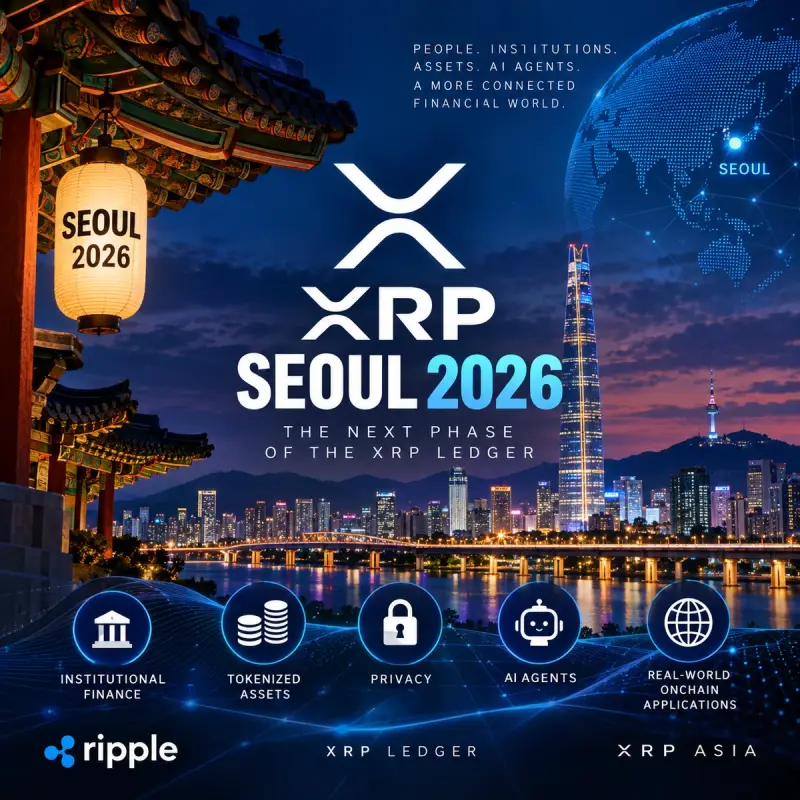
XRP ASIA LAUNCHES AS THE XRPL ROADMAP PUTS PRIVACY, AI AGENTS AND NEXT-GENERATION FINANCIAL APPLICATIONS IN THE SPOTLIGHT
XRP SEOUL 2026 LOOKS TOWARD THE NEXT PHASE OF THE XRP LEDGER
While much of the public discussion around XRP continues to focus on price, developers and institutions are increasingly focused on a different question: What infrastructure does the XRP Ledger need to support the next generation of institutional financial applications?
At XRP Seoul 2026, those questions moved into the spotlight. The event focused on areas including XRP utility, privacy technologies, AI-driven applications, agentic finance, tokenized assets and the institutional development of the XRP Ledger.
At the same time, XRP Asia was introduced as an initiative aimed at accelerating the growth of the XRP Ledger ecosystem across the Asia-Pacific region, with a focus on developers, businesses, institutions and regional communities.
The developments are significant because they show how the conversation around XRPL is expanding beyond traditional cross-border payments. Tokenization, institutional finance, programmable assets, privacy and AI-driven transactions could all become important components of the ledger’s next phase.
However, one distinction remains essential: greater adoption of the XRP Ledger does not automatically translate into equivalent demand for XRP. The key question is what role the native asset XRP will actually play within these applications.
WHAT WAS ACTUALLY PRESENTED AT XRP SEOUL 2026?
The official XRP Seoul 2026 program provides a clear indication of where development around the XRP Ledger is heading. The agenda included XRP utility, tokenized assets, the Agentic Economy on XRPL, institutional financial applications, cross-border payments and tokenized deposits.
One particularly notable session featured Ripple President Monica Long under the title “How Ripple Is Bringing XRP Utility Into Institutional Finance.” Representatives from Kbank, Kyobo Securities, Woori Bank and JB Bank also joined Ripple to discuss the evolution from cross-border payments toward tokenized deposits.
Another major focus was the Agentic Economy – a future in which autonomous software and AI agents could initiate payments, purchase services or perform other financial actions within predefined rules. The official program dedicated multiple sessions to this subject, including “The Agentic Economy on the XRP Ledger” and “Building a Trusted Agentic Economy on the XRP Ledger.”
Reports covering the technical presentations highlighted concepts including verifiable identities for AI agents, permissions and spending limits, smart wallets capable of holding XRP and stablecoins, privacy technologies and transaction batching for more complex applications.
Privacy is particularly important for institutional users. Banks and financial institutions cannot necessarily expose sensitive transaction information publicly on a blockchain. Technologies based on zero-knowledge proofs could allow certain information to remain confidential while still enabling the validity of transactions to be cryptographically verified.
It is important, however, not to treat every technology discussed at the event as a feature that is already fully operational on the XRPL mainnet. Some developments remain part of the roadmap, development process or XRPL amendment process, where activation may ultimately depend on technical completion and validator approval.
The direction is nevertheless becoming increasingly clear: the XRP Ledger is being developed beyond fast payments toward infrastructure capable of supporting institutional financial products, tokenized assets and increasingly automated financial applications.
XRP ASIA: A NEW PUSH FOR XRPL GROWTH ACROSS ASIA
One of the most important developments surrounding XRP Seoul 2026 was the growing visibility of XRP Asia, an initiative focused on expanding the XRP Ledger ecosystem across the Asia-Pacific region.
The organization is led by Sabrina Tachdjian, formerly Vice President at the Hedera Foundation. At XRP Seoul 2026, XRP Asia appeared prominently in the official program in the session “Special Announcement: What’s Coming Next for the XRP Ecosystem in Asia” together with Ripple’s Tatsuya Kohrogi.
The initiative is intended to go beyond traditional community building. Its focus includes developer support, education, startup assistance, market-entry support and collaboration with businesses and financial institutions – with the broader goal of strengthening the regional ecosystem around the XRP Ledger.
The institutional dimension was also visible throughout XRP Seoul. Representatives from Kbank, Kyobo Securities, Woori Bank and JB Bank joined Ripple to discuss the path from cross-border payments toward tokenized deposits. Other sessions featured participants from organizations including Kakao Bank, SC Ventures and Meritz Securities.
This gives the Asia strategy an important additional dimension. The objective is not simply to attract more XRP holders. It is about bringing developers, applications, companies and potentially institutional financial infrastructure onto the XRP Ledger.
The Asia-Pacific region could be particularly important in that process. XRP Seoul itself positions the event around institutional blockchain adoption and real-world onchain applications, bringing together financial institutions, developers and companies working across the digital-asset ecosystem.
For XRP holders, however, the same distinction remains important: more XRPL adoption does not automatically mean more XRP demand.
The key question will be whether applications emerging from this regional expansion actually use XRP for liquidity, settlement, collateral or as a bridge asset.
That is why XRP Asia will be worth watching beyond the launch itself. The real measure of success will be which developers, companies, financial institutions and real-world applications ultimately build on or integrate with the XRP Ledger.
PRIVACY ON XRPL: WHY CONFIDENTIALITY MATTERS FOR BANKS
Public blockchains are built around transparency. For banks and institutional market participants, however, that transparency can also create a problem. Financial institutions cannot necessarily expose sensitive information about transaction amounts, client positions, liquidity or trading activity on a public ledger.
RippleX is therefore working on privacy capabilities for the XRP Ledger designed to provide confidentiality without sacrificing the verifiability of public blockchain infrastructure. Ripple has identified zero-knowledge proofs as an important component of its institutional DeFi roadmap.
One of the key concepts is Confidential Transfers for Multi-Purpose Tokens (MPTs). The goal is to cryptographically conceal transaction amounts and balances while still allowing validators to verify that a transaction is valid. At the same time, selective disclosure could allow authorized parties to access information when required for auditing or regulatory purposes.
This combination could be particularly important for institutional finance:
public settlement – but confidential financial information.
The objective is to create a bridge between two worlds. The advantages of public blockchain infrastructure – shared settlement, cryptographic verification and auditability – can remain, while sensitive financial information does not necessarily need to be visible to everyone.
That could be relevant for tokenized securities, institutional liquidity, real-world assets and other regulated financial products. Ripple has described privacy with accountability as an important component of the next phase of institutional DeFi on XRPL.
Privacy was again a prominent theme around XRP Seoul 2026, where technical discussions focused on how confidentiality could help make public blockchain infrastructure more suitable for institutional use.
One point remains important: not every proposed privacy capability is already fully active on the XRP Ledger mainnet. Some features remain in development or must progress through XRPL’s amendment and validator processes before activation.
The strategic direction, however, is clear. If banks and institutional investors are expected to move larger parts of financial activity onto public blockchain infrastructure, privacy combined with regulatory accountability may become one of the most important requirements.
AI AGENTS AND “AGENTIC FINANCE”: WHEN SOFTWARE STARTS MAKING PAYMENTS
One of the most forward-looking themes at XRP Seoul 2026 was the Agentic Economy – a financial environment in which AI agents do more than analyse information. Within predefined rules, they could independently purchase services, pay for data or computing resources, settle invoices and initiate other financial transactions.
The topic received several dedicated sessions on the official XRP Seoul agenda. Ripple and t54 Labs discussed both “The Agentic Economy on the XRP Ledger: From Use Cases to Adoption” and “Building a Trusted Agentic Economy on the XRP Ledger.”
This is no longer purely theoretical. Ripple has already released the XRPL AI Starter Kit, which supports X402-based payments using both XRP and Ripple USD (RLUSD). It is designed to help developers build applications in which AI agents can autonomously pay for APIs, computing resources and other digital services.
But autonomous payments require much more than a wallet. If software is allowed to spend money independently, identity, permissions, spending limits, risk controls and traceability become essential.
This is where infrastructure discussed around XRP Seoul becomes particularly interesting. Reports from the event highlighted concepts such as verifiable identities for agents, predefined spending limits and smart wallets capable of managing both XRP and stablecoins.
XRPL also provides mechanisms that can help make automated activity traceable. Official XRP Ledger documentation describes ways to associate transactions with specific agents or workflows using identifiers, structured metadata and real-time transaction monitoring.
The long-term scenario is potentially significant: an AI agent could operate within clearly defined limits and independently purchase and pay for digital services, while the individual or company controlling it retains authority over what the agent is permitted to do and how much it may spend.
For XRP, this creates an interesting – but not guaranteed – opportunity. Ripple’s XRPL AI Starter Kit supports payments using both XRP and RLUSD. An increase in automated transactions on the XRP Ledger therefore does not necessarily mean that every transaction creates additional demand for XRP.
The key question will be which assets AI agents actually use for payments, liquidity and settlement.
That is what makes Agentic Finance strategically interesting. If autonomous software eventually handles a meaningful share of digital commerce, blockchain networks may no longer connect only people and financial institutions. They could also connect machines, applications and AI agents conducting economic activity with one another around the clock.
WHAT DOES XRP SEOUL 2026 MEAN FOR XRP?
XRP Seoul 2026 highlights how development around the XRP Ledger is moving increasingly beyond traditional payments. The official agenda covered XRP utility, institutional finance, tokenized deposits and assets, real-world onchain applications and the Agentic Economy on XRPL.
For XRP, this direction is potentially significant. XRP is the native digital asset of the XRP Ledger and can be used for transaction fees as well as liquidity and bridge-asset functions within the ecosystem. Ripple’s XRPL AI Starter Kit also supports agent-based payments using both XRP and RLUSD.
However, this leads to an important distinction:
A growing XRP Ledger does not automatically create proportional demand for XRP.
If tokenized assets, stablecoins, banks or AI agents use XRPL, the direct impact on XRP will depend on which assets are actually used for payments, liquidity, settlement and exchange between different markets.
At the same time, a substantially larger XRPL ecosystem could create more situations in which XRP has a functional role. This becomes particularly interesting when different currencies, stablecoins and tokenized assets need to interact or when liquidity must move efficiently between different markets.
Privacy capabilities could also become relevant here. Confidential Transfers are designed to allow transaction amounts and balances to remain private while retaining cryptographic verification and potential auditability – requirements that could be important for regulated institutional finance.
The expansion of the ecosystem in Asia adds another dimension. If initiatives such as XRP Asia succeed in attracting developers, companies and financial institutions, the XRP Ledger could host a broader range of real-world applications.
But for long-term XRP observers, the most important metrics will not simply be the number of new features or announcements.
They will be real applications, institutional usage, transaction volume, liquidity – and the specific role XRP actually plays within those financial flows.
Perhaps the most important message from XRP Seoul 2026 is therefore not a single announcement, but the direction of travel: XRPL is being developed as infrastructure where people, financial institutions, tokenized assets and potentially autonomous AI agents could interact economically on the same network.
THE BIGGER PICTURE – FROM SEOUL TO THE NEXT PHASE OF THE XRP LEDGER
XRP Seoul 2026 was less about the short-term price of XRP and more about a much bigger question: What could the XRP Ledger actually be used for in the financial system of the future?
The event’s official program covered a remarkably broad range of topics, including XRP utility, tokenized assets, institutional finance, cross-border payments, tokenized deposits, the Agentic Economy and real-world onchain applications. Ripple representatives appeared alongside banks, securities firms, developers and companies from across the Asia-Pacific region.
At the same time, the technical direction around XRPL is expanding far beyond fast payments. Privacy, tokenization, institutional infrastructure and autonomous AI agents point toward a network designed to support increasingly sophisticated financial activity.
For a complete overview of how these technologies could connect with payments, RLUSD, tokenization, institutional DeFi and XRP liquidity, see the XRP Ledger Institutional Finance Map 2026.
The institutional component is particularly important. Representatives from Kbank, Kyobo Securities, Woori Bank and JB Bank joined Ripple in discussions about the evolution from cross-border payments toward tokenized deposits. Other sessions included participants from organizations such as Kakao Bank, SC Ventures and Meritz Securities.
However, their participation at XRP Seoul should not be interpreted as confirmation that these institutions are adopting XRP or deploying the XRP Ledger in production. Conference participation and discussions are not the same as announced partnerships or live implementations.
For XRP, the central question therefore remains:
Can a larger XRP Ledger ecosystem ultimately translate into greater functional use of XRP itself?
Privacy technologies, tokenized assets, institutional applications and autonomous AI agents could all increase activity on XRPL. But some of those applications may also use stablecoins or other digital assets. Growth of the ledger therefore does not automatically imply proportional growth in XRP demand.
The long-term metrics that matter will be real-world applications, institutional adoption, transaction volume, liquidity and the specific role XRP plays within those financial flows.
That is what makes XRP Seoul 2026 significant. The event suggests a broader ambition for XRPL: not simply to transfer value quickly, but to provide infrastructure where banks, businesses, tokenized assets, stablecoins and potentially autonomous AI agents can interact within the same digital financial ecosystem.
The next phase of the XRP Ledger may therefore be defined not by a single feature or announcement, but by whether these technologies develop into real financial activity at scale.
WANT TO UNDERSTAND WHY THESE DEVELOPMENTS MATTER FOR XRP?
Privacy, tokenized assets, AI agents and institutional finance are difficult to understand in isolation. To see the bigger picture, it helps to understand how today’s financial system works – and which problems new technologies are actually trying to solve.
“XRP – When the Giant Awakens” by Adrian Caldor goes far beyond XRP. Across more than 500 pages, the book explains the financial system from the ground up – from money creation, banks, central banks and inflation to global payments, blockchain, stablecoins, tokenization, Ripple, the XRP Ledger and XRP.
No prior knowledge required. The book starts with the financial system and builds step by step toward XRP.
Available as Paperback & Kindle eBook.
SOURCES
XRP Seoul 2026 – Official Program
Official agenda covering XRP utility, institutional finance, tokenized deposits, the Agentic Economy and the XRP ecosystem in Asia.
XRP Seoul 2026 – Official Program
Ripple – XRPL AI Starter Kit
Official Ripple information on AI-agent payments and the use of XRP and RLUSD for autonomous digital payments.
XRP Ledger – Confidential Transfers
Official XRPL documentation covering confidential token transfers, encrypted balances, zero-knowledge proofs and auditability.
XRP Ledger – Confidential Transfers
XRP Ledger – Tracking Agent Behavior
Official XRPL documentation explaining how automated agents and their transactions can be identified and monitored.
Add comment
Comments