

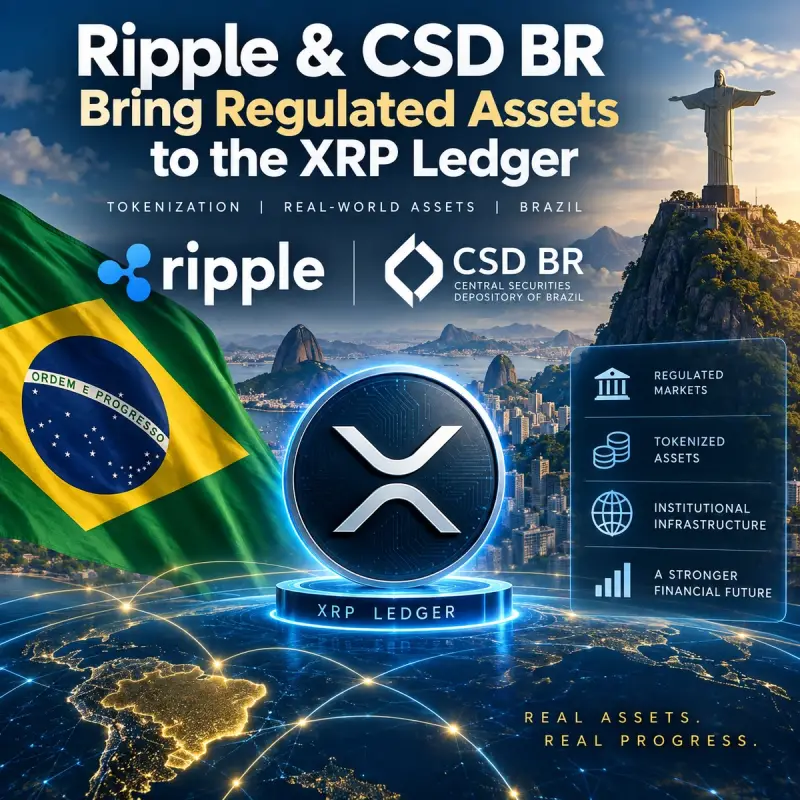
RIPPLE BRINGS REGULATED FINANCIAL ASSETS TO THE XRP LEDGER IN BRAZIL
XRP LEDGER ENTERS BRAZIL’S REGULATED FINANCIAL INFRASTRUCTURE
Ripple and Brazilian financial market infrastructure provider CSD BR have launched the first phase of a partnership that brings the XRP Ledger into live, regulated financial-market operations in Brazil.
The project begins with investment fund shares issued by BTG Pactual and deposited at CSD BR. These assets will be represented and mirrored on the XRP Ledger using XRPL’s Multi-Purpose Token (MPT) standard, creating an additional blockchain-based layer for record verification and auditing. Ripple
Importantly, CSD BR’s existing systems remain the official source of record for registration, deposit and settlement. The XRP Ledger does not replace that infrastructure in this first phase. Instead, it provides a complementary layer that allows authorized participants to compare records and verify their consistency in near real time. Ripple
That distinction matters. This is not simply another announcement about a blockchain proof of concept. According to Ripple and CSD BR, the technology is being evaluated with live transactions inside an existing regulated market environment.
WHAT DOES BRL 22 TRILLION ACTUALLY MEAN?
CSD BR states that its regulated infrastructure has more than BRL 22 trillion in registered assets and is capable of processing millions of transactions within minutes. That scale makes the partnership significant – but the figure needs to be understood correctly. Ripple
It does not mean that BRL 22 trillion of assets are being tokenized on the XRP Ledger.
The initial phase is much narrower. It begins with BTG Pactual investment fund shares deposited at CSD BR, which will be tokenized and mirrored on XRPL. CSD BR’s existing systems continue to maintain the official records for registration, deposit and settlement. Ripple
The BRL 22 trillion figure instead demonstrates the scale of the regulated financial infrastructure into which XRPL is being introduced. If the initial phase performs successfully, Ripple and CSD BR say later stages could expand toward native issuance and trading between authorized participants. Brazilian real-estate receivables certificates (CRI) and agribusiness receivables certificates (CRA) are among the asset classes being considered. Ripple
That makes the development particularly interesting: the story is not that trillions of reais have suddenly moved onto XRPL, but that a public blockchain is being integrated into financial-market infrastructure that already operates at trillion-real scale.
WHY THIS MATTERS FOR THE XRP LEDGER
The significance of the CSD BR partnership goes beyond the tokenization of a single group of investment fund shares. It demonstrates how the XRP Ledger can be integrated into existing regulated financial infrastructure without requiring institutions to abandon their current systems from day one. Ripple
In the first phase, XRPL acts as a complementary record and audit layer. Authorized institutions can compare blockchain-based records with CSD BR’s official records in near real time. The architecture also supports institutional requirements such as permissioned participation, KYC and AML procedures, asset freezing and clawback functionality when required by regulators or courts. Ripple
This is important for the broader tokenization market. For a broader overview of how tokenization, stablecoins, institutional DeFi, privacy and XRP could fit together, see the XRP Ledger Institutional Finance Map 2026. Financial institutions are unlikely to replace decades of established infrastructure overnight. A model in which blockchain technology is introduced alongside existing systems may provide a more realistic path toward wider institutional adoption.
If the initial phase is successfully validated, Ripple and CSD BR plan to explore native asset issuance and trading between authorized participants on the XRP Ledger. Potential future asset classes include Brazilian real-estate receivables certificates (CRI) and agribusiness receivables certificates (CRA). Ripple
For XRPL, this represents another step toward a broader role as infrastructure for tokenized real-world assets, regulated financial products and institutional blockchain applications. Ripple describes XRPL as a Layer-1 network designed for the tokenization and exchange of both crypto-native and real-world assets. Ripple
One distinction remains important: greater institutional use of the XRP Ledger does not automatically translate into equivalent demand for XRP itself. XRP is the native asset of XRPL and has functions including transaction fees, network reserves and liquidity use cases, but the direct role of XRP depends on how individual applications and financial flows are structured.
FROM TOKENIZATION TO REAL-WORLD FINANCIAL INFRASTRUCTURE
For years, tokenization has been discussed as one of blockchain’s most promising institutional use cases. The challenge has never been simply creating a digital token. The harder task is connecting blockchain technology with regulated markets, custody, compliance, settlement and legally recognized ownership records.
The CSD BR initiative is notable because it introduces XRPL into an existing regulated market structure rather than creating an isolated blockchain experiment. CSD BR will remain the official source of record, while the XRP Ledger initially provides an additional layer for recording, reconciliation and auditing. Ripple
This approach could offer institutions a gradual path toward blockchain adoption. Existing financial infrastructure does not need to disappear overnight. Instead, blockchain can first operate alongside established systems, allowing institutions and regulators to evaluate transparency, traceability, automation and operational efficiency using live transactions. Ripple
The technology being used is also significant. The project will use XRPL’s Multi-Purpose Token (MPT) standard, which was designed with institutional tokenization in mind and supports features including authorization, supply controls, metadata, freezing and clawback. docs.ripple.com
If the model develops as planned, later phases could move beyond record mirroring toward native issuance and trading of regulated assets directly on XRPL among authorized participants. CSD BR and Ripple specifically identify Brazilian CRI real-estate receivables certificates and CRA agribusiness receivables certificates as potential future asset classes. Ripple
That is where the broader significance lies: XRPL is being tested not merely as a place to create tokens, but as infrastructure that could potentially support parts of real-world regulated capital markets.
WHAT COULD THIS MEAN FOR XRP?
The CSD BR partnership is clearly significant for the XRP Ledger, but its implications for XRP itself require a more careful distinction.
XRP is the native digital asset of the XRP Ledger. It is used for transaction fees, network reserves and can serve as a bridge asset for liquidity between different currencies and assets. Ripple also describes XRP as the native bridge asset within XRPL’s decentralized exchange. Ripple
However, the fact that regulated financial assets are recorded or tokenized on XRPL does not automatically mean that institutions must purchase large amounts of XRP. In the CSD BR project, the immediate purpose of XRPL is to provide an additional record and auditing layer for selected BTG Pactual fund shares. CSD BR’s own systems remain the official source of record. Ripple
The longer-term question is therefore more interesting: What happens if XRPL evolves from record mirroring into an infrastructure where regulated assets are issued, traded and settled directly on the ledger?
Ripple and CSD BR already state that future phases could include native issuance and trading between authorized participants, potentially involving Brazilian real-estate and agribusiness receivables. Ripple
If that happens at meaningful scale, the XRP Ledger could host an increasingly diverse ecosystem of tokenized securities, stablecoins, currencies and other digital assets. XRP could potentially play a role in connecting liquidity between those assets – but the extent of that role will depend on how institutions actually structure their transactions and settlement flows.
That is the distinction worth watching:
XRPL adoption is not automatically XRP adoption. But a larger financial ecosystem built on XRPL could create more opportunities for XRP to be used for liquidity, settlement and asset exchange.
For long-term observers of XRP, the important metric may therefore be not only how many institutions announce partnerships with Ripple, but how much real financial activity ultimately moves onto the XRP Ledger – and what role XRP plays inside those flows.
THE BIGGER PICTURE
The CSD BR partnership represents something broader than another tokenization announcement. It shows how public blockchain infrastructure can begin entering regulated capital markets through a gradual integration with systems that already exist today.
In the first phase, the XRP Ledger will not replace CSD BR’s official infrastructure. Instead, it will operate alongside it as an additional layer for recording, reconciliation and auditing. If that model proves successful under live market conditions, later phases could expand toward native issuance and trading of regulated financial assets on XRPL among authorized participants. Ripple
That progression – from experimentation, to record mirroring, to potential native issuance and trading – may ultimately be more important than headline tokenization numbers.
For XRP and XRPL observers, the development also reinforces an important distinction: the long-term story is not simply about the price of XRP. It is about whether the XRP Ledger can become part of the infrastructure through which real financial assets, stablecoins, tokenized securities and institutional liquidity interact.
Brazil is particularly interesting in this context because this project involves regulated financial-market infrastructure operating at substantial scale. CSD BR reports more than BRL 22 trillion in registered assets, although only selected BTG Pactual fund shares are included in the initial XRPL phase. Ripple
The next milestones will therefore matter more than the announcement itself: successful operation of the mirroring phase, expansion to additional asset classes, native issuance, trading between authorized participants – and ultimately whether these developments generate meaningful onchain activity.
The important question is no longer simply whether traditional finance will experiment with blockchain. It is how deeply blockchain infrastructure will become integrated into the financial system that already exists.
WANT TO UNDERSTAND THE BIGGER PICTURE BEHIND XRP?
The integration of blockchain into regulated financial markets cannot be understood by looking at XRP alone. It requires an understanding of how money, banks, liquidity, international payments and today’s financial infrastructure actually work.
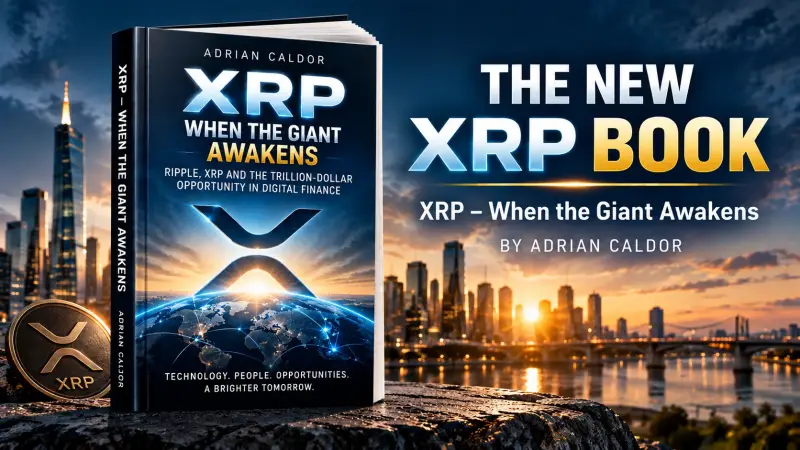
“XRP – When the Giant Awakens” by Adrian Caldor goes far beyond XRP. Across more than 500 pages, the book explains the financial system from the ground up – from money creation, banks, central banks and inflation to global payments, blockchain, stablecoins, tokenization, Ripple and the XRP Ledger.
No prior knowledge required. The book starts with the financial system – and builds step by step toward XRP.
Available as Paperback & Kindle eBook.
SOURCES
Ripple – CSD BR and Ripple Use the XRP Ledger to Expand Brazil’s Financial Market Infrastructure
Official announcement of the CSD BR partnership, including the first phase involving BTG Pactual investment fund shares, the use of XRPL as an additional record and audit layer, and CSD BR’s more than BRL 22 trillion in registered assets. Ripple
Ripple – CSD BR and XRP Ledger Partnership
XRP Ledger – Multi-Purpose Tokens (MPTs)
Official XRPL documentation explaining the MPT standard, including authorization, supply controls, metadata, freezing and clawback functionality relevant to institutional tokenization. xrpl.org
XRP Ledger – Multi-Purpose Tokens
XRP Ledger – Tokenization and Real-World Assets
Official XRPL educational material covering real-world asset tokenization and how MPTs are designed to support compliant institutional assets on the XRP Ledger. learn.xrpl.org
XRP Ledger – Tokenization and Real-World Assets
Add comment
Comments