

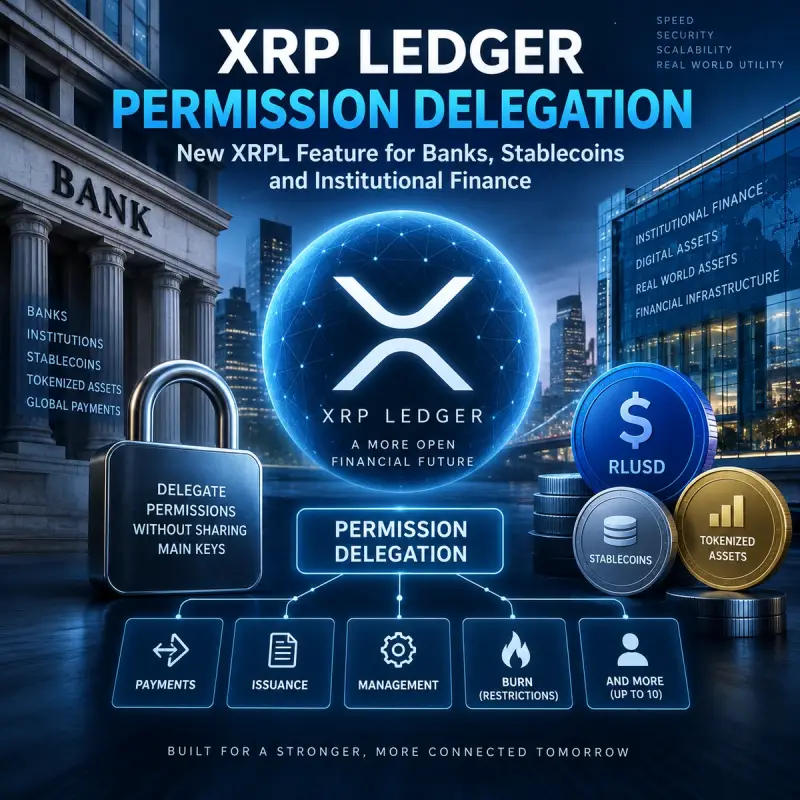
The XRP Ledger has activated PermissionDelegationV1_1, a new feature that could be especially relevant for banks, stablecoin issuers and other institutional users. Since October 8, 2026, account owners can grant specific permissions to separate accounts without sharing the primary keys that control their main holdings.
From a technical perspective, this is not a spectacular price catalyst. However, it is important for the long-term development of the XRP Ledger because it addresses a key requirement for institutional finance: different responsibilities and permissions can now be separated more clearly within an organization.
That means a company could, for example, authorize one account to handle payments while another account is responsible for compliance-related tasks. The main account keeps control of its own keys, and the delegated permissions can later be changed or revoked.
What Does Permission Delegation Mean on the XRP Ledger?
Permission Delegation allows an XRP Ledger account owner to grant specific permissions to another account without giving that account full control over the primary wallet.
This is especially important for companies, banks and institutional users because different departments or systems often need different levels of access.
For example, one account could be authorized to handle payments, while another account could be responsible for certain token-related or compliance functions. The main account keeps control of its own keys and can later change or revoke the delegated permissions.
This creates a more flexible permission structure and brings the XRP Ledger closer to the type of role-based access systems commonly used in traditional financial institutions.
Why Is This Important for Banks and Institutional Users?
Institutional blockchain use is very different from managing a private wallet.
A single user can control funds and sign transactions independently. Banks, funds and large companies, however, usually separate responsibilities across different people, departments and systems.
Ripple’s recent cooperation with Meritz Securities in South Korea also shows how strongly institutional financial infrastructure is becoming part of the broader Ripple ecosystem.
Typical functions can include:
- payment processing
- compliance procedures
- digital asset management
- token issuance
- operational controls
- internal security processes
Permission Delegation makes it possible to separate these functions more clearly without giving multiple operational teams access to the main account keys.
This could become especially relevant if the XRP Ledger is used more widely for stablecoins, tokenized assets and other institutional financial applications.
Up to Ten Different Permissions per Account
A delegated account can receive up to ten different permissions.
These permissions do not automatically define a specific spending amount. Instead, they determine which types of actions the delegated account is allowed to perform.
The owner of the main account can later modify or revoke these permissions if necessary.
This is an important distinction: Permission Delegation is not simply about creating additional access. It is about giving institutions more precise control over who is allowed to perform which function on the XRP Ledger.
One Important Limitation Remains
The activation of Permission Delegation also comes with an important technical warning.
Developers currently advise against delegating the PaymentBurn permission until a separate fix has been activated.
Under certain conditions, this permission could potentially cause issued tokens to behave in an unintended way.
Important:
This warning affects issued tokens on the XRP Ledger. It does not mean that new XRP can be created.
The issue shows why major network upgrades must be implemented carefully.
The importance of network security was also highlighted by the recent XRP Ledger 3.4.1 Security Update.
New features can create important opportunities for institutional users, but they also need to be technically robust and thoroughly tested.

XRP Ledger Is Moving Further Toward Institutional Infrastructure
The XRP Ledger is increasingly being developed not only as a network for fast XRP transactions, but also as infrastructure for:
- stablecoins
- tokenized assets
- institutional payments
- digital financial products
- automated financial applications
This institutional direction was also visible at XRP Seoul 2026, where privacy, AI and the future of institutional XRP Ledger applications were key themes.
Ripple itself is also increasingly focused on institutional financial infrastructure, international payments, custody and stablecoins.
Ripple Swell 2026 also highlighted the growing importance of institutional adoption, digital assets and blockchain infrastructure in global finance.
However, it is important to distinguish between Ripple, XRP and the XRP Ledger.
Ripple is a company. XRP is the native digital asset of the XRP Ledger. The XRP Ledger is an independent decentralized blockchain network.
Permission Delegation adds another layer of functionality that could make the XRP Ledger more practical for banks, financial institutions and other professional organizations with complex internal structures.
By allowing specific permissions to be delegated without giving up control of the main account keys, the network becomes better suited to institutional environments where responsibilities, compliance functions and operational roles need to be clearly separated.
For a broader overview of how the XRP Ledger is evolving toward institutional financial infrastructure in 2026, see our XRP Ledger Institutional Finance Map.
What Role Could RLUSD Play?
RLUSD, Ripple’s U.S. dollar-backed stablecoin, can be used on the XRP Ledger.
That means new XRPL features that improve permission management and institutional control could also become relevant for regulated stablecoin applications.
Permission Delegation does not automatically mean that RLUSD usage will increase.
Its importance lies in the fact that the XRP Ledger is gaining more of the technical tools that professional and regulated financial organizations may require.
For institutions working with stablecoins, tokenized assets and digital payments, more granular control over account permissions could become increasingly valuable.
What Does This Mean for XRP?
A new XRP Ledger feature does not automatically create higher demand for XRP or lead to a higher XRP price.
However, the continued development of the network remains important for the long-term XRP ecosystem.
If more banks, financial institutions, stablecoin issuers and tokenized asset platforms begin using the XRP Ledger, the underlying infrastructure needs to support not only fast and inexpensive transactions, but also complex institutional requirements.
Permission Delegation is therefore less about short-term market excitement and more about making the XRP Ledger more suitable for professional financial use.
The more mature and flexible the network becomes, the more relevant it could become for future institutional applications.
Learn More About XRP, Ripple and the Future of Digital Finance
If you want to understand the bigger picture behind XRP, Ripple, the XRP Ledger, RLUSD, stablecoins, tokenization and institutional adoption, my book “XRP – WHEN THE GIANT AWAKENS” provides a much deeper overview.
The book explains not only the XRP ecosystem, but also the foundations of today’s financial system — from banks, money creation and inflation to blockchain, digital assets and the possible future of international financial infrastructure.
Place the book promotional video here.
Directly below the video, place the English book cover.
XRP – WHEN THE GIANT AWAKENS
Ripple, XRP and the Trillion-Dollar Opportunity in Digital Finance
by Adrian Caldor

Conclusion
PermissionDelegationV1_1 shows the direction in which the XRP Ledger is continuing to evolve.
The network is no longer focused only on fast and inexpensive transactions. It is increasingly gaining features designed for more complex institutional structures.
The ability to delegate specific permissions to separate accounts without sharing the main account keys is much closer to the security and organizational requirements used by banks, financial institutions and large companies.
At the same time, the current warning around PaymentBurn shows that new features still need to be implemented and monitored carefully.
For XRP, this does not automatically mean higher demand or a higher price. But for the long-term development of the XRP Ledger, Permission Delegation is another step toward more professional financial infrastructure.
Sources
For the English article, use these sources at the bottom:
-
XRPL.org – Permission Delegation
Official documentation for Permission Delegation and delegated permissions on the XRP Ledger. -
XRPL.org – Known Amendments
Official amendment overview for PermissionDelegationV1_1 and related network changes. -
XLS-75 – Permission Delegation
Technical specification for the permission delegation standard, including the limit of up to ten permissions. -
CoinDesk – October 9, 2026
XRP Ledger adds new controls for banks, stablecoins and tokenized funds
Useful journalistic summary of the activation, institutional use cases and the PaymentBurn warning.
Add comment
Comments