

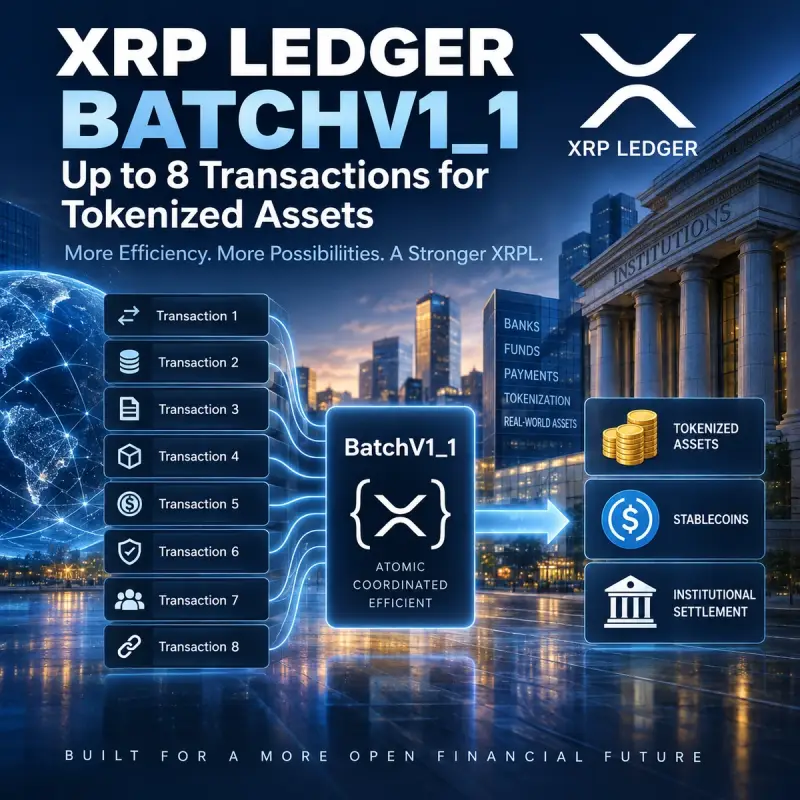
The XRP Ledger is introducing BatchV1_1, a new feature that allows multiple transactions to be grouped into a single coordinated process.
The upgrade can bundle up to eight transactions and, depending on the configuration, can execute them under an all-or-nothing model.
For simple XRP payments, this may not be necessary.
For institutional finance, tokenized assets and more complex settlement processes, however, the feature could become much more important.
One possible example:
A tokenized asset could be transferred while the corresponding payment is executed at the same time. If one side of the transaction fails, the entire process can be cancelled.
This brings the XRP Ledger closer to financial-market workflows commonly described as Delivery versus Payment.
In simple terms, the asset and the payment are settled together instead of one party delivering first and waiting for the other side to complete its part.
How Does BatchV1_1 Work?
BatchV1_1 allows several individual XRP Ledger transactions to be grouped into one coordinated process.
Different execution rules can be used, but one of the most important options is the ability to link several transactions so that they only succeed together.
A simple example:
An investor buys a tokenized asset. At the same time, the corresponding payment has to be completed.
With a batch structure, both steps could be connected:
- transfer of the tokenized asset
- payment of the purchase price
If one of the two steps fails, the entire process can be cancelled.
This reduces the risk that one party has already delivered while the other side has not yet completed its part.
For institutional finance, this kind of coordinated settlement can be especially important.
Why Is the All-or-Nothing Logic So Important?
For institutional financial transactions, it is often not enough for individual transactions to simply execute quickly.
What matters is that several related steps happen in a coordinated way.
For example, if a tokenized security is transferred while the corresponding payment is made at the same time, both sides of the transaction should ideally succeed together.
BatchV1_1 can technically link those steps more closely.
This can be especially relevant for:
- tokenized securities
- real-world assets
- stablecoin-based payments
- institutional trading processes
- automated settlement workflows
As more financial products move onto blockchain infrastructure, mechanisms like this become increasingly important.
Professional market participants need not only speed, but also predictability, security and atomic settlement.

Why Is BatchV1_1 Especially Relevant for Tokenized Assets?
Tokenized assets represent real or traditional financial assets digitally on a blockchain.
These can include:
- bonds
- fund shares
- stocks
- real estate interests
- commodities
- other real-world assets
For these products, a simple asset transfer is often not enough.
An institutional transaction may require several steps to happen together, such as:
- transferring the tokenized asset
- paying the purchase price
- checking specific conditions
- updating related accounts or permissions
BatchV1_1 can help coordinate these processes more efficiently by grouping several transactions into one structured workflow.
This becomes especially interesting if the XRP Ledger is increasingly used for tokenized financial products and institutional settlement.
In that sense, BatchV1_1 turns individual blockchain transactions into a more coordinated multi-step process.
Connection to Stablecoins and Institutional Payments
BatchV1_1 could also become relevant for stablecoin-based financial processes.
If an institutional transaction involves several steps, payments, asset transfers and other actions can be linked more closely.
One possible example:
- a tokenized asset is transferred
- payment is made with a stablecoin at the same time
- both steps are executed only if the full process succeeds
In scenarios like this, RLUSD could also become relevant if the stablecoin is used in corresponding applications on the XRP Ledger.
However, one point is important:
BatchV1_1 does not automatically mean that RLUSD will be used in these transactions.
The feature primarily creates the technical foundation for coordinating several related actions more efficiently and securely on the XRP Ledger.
Why Could BatchV1_1 Matter for Banks and Institutional Users?
Institutional financial processes often involve more than a single action.
Banks, funds, brokers and other professional market participants may need to coordinate several steps, such as:
- payment
- transfer of an asset
- permission checks
- accounting updates
- settlement
- internal control processes
If these steps are executed independently, additional risks can arise.
BatchV1_1 can help link several transactions more closely and make it easier to represent complex workflows directly on the XRP Ledger.
This is especially relevant for applications where not only speed matters, but also correct sequencing, dependencies and coordinated execution.
The more the XRP Ledger develops toward institutional financial infrastructure, the more important these types of features could become.
Ripple’s recent cooperation with Meritz Securities in South Korea also shows how strongly institutional financial infrastructure is becoming part of the broader ecosystem.
Verlinke nur: cooperation with Meritz Securities in South Korea
How Does BatchV1_1 Fit Into the Broader XRPL Development?
BatchV1_1 is not an isolated upgrade.
The XRP Ledger is currently gaining several features that are aimed at more complex professional and institutional use cases.
These include:
- Permission Delegation for more granular access control
- improvements in security and network resilience
- expanded support for tokenized assets
- stronger infrastructure for institutional payments and settlement
BatchV1_1 complements these developments by allowing not only individual actions, but entire transaction workflows to be coordinated more effectively.
This makes the XRP Ledger technically more suitable for applications in which several steps belong together and should not be executed independently.
In combination with tokenization, stablecoins and institutional financial products, this type of functionality could become increasingly important over time.
XRP Seoul 2026 also highlighted institutional applications, tokenization and the continued development of the XRP Ledger.
For a broader overview of how these developments fit together, see our XRP Ledger Institutional Finance Map 2026.
What Does BatchV1_1 Mean for XRP?
A new XRP Ledger feature does not automatically create higher demand for XRP or lead to a higher XRP price.
The long-term value of upgrades like BatchV1_1 lies in making the network more capable and better suited for complex financial applications.
If more institutional processes move onto the XRP Ledger in the future, XRP could benefit indirectly through:
- higher network activity
- broader use of the XRP Ledger
- greater liquidity demand
- additional institutional applications
- growing relevance of XRPL-based financial products
The key factor is therefore not the technical feature alone, but whether it is actually used in real-world applications.
BatchV1_1 is best viewed as another building block in the XRP Ledger’s development toward broader financial infrastructure.
Learn More About XRP, Ripple and the Future of Digital Finance
If you want to understand the bigger picture behind XRP, Ripple, the XRP Ledger, RLUSD, tokenization and institutional finance, my book “XRP – WHEN THE GIANT AWAKENS” provides a much deeper overview.
The book explains not only the XRP ecosystem, but also the foundations of today’s financial system — from banks, money creation and inflation to blockchain, stablecoins, tokenized assets and the possible future of international financial infrastructure.

XRP – WHEN THE GIANT AWAKENS
Ripple, XRP and the Trillion-Dollar Opportunity in Digital Finance
by Adrian Caldor
Conclusion
BatchV1_1 shows how the XRP Ledger is continuing to evolve toward more complex financial applications.
The ability to bundle multiple transactions and coordinate them through an all-or-nothing model is especially relevant for tokenized assets, stablecoins and institutional settlement processes.
For banks, funds and other professional market participants, speed alone is not enough. They also need transaction flows in which several related steps can be executed reliably and in the correct order.
That is where BatchV1_1 could become particularly important.
For XRP, this does not automatically mean a direct price impact.
The feature becomes relevant if it is actually used in real-world applications and contributes to more institutional activity on the XRP Ledger.
Over the long term, BatchV1_1 is another building block in the XRP Ledger’s development toward broader institutional financial infrastructure.
Sources
-
CoinDesk – XRP Ledger’s Batch upgrade slips to Oct. 9 after validator support resets
Quelle für BatchV1_1, die Bündelung von bis zu acht Transaktionen und mögliche atomare Abläufe für tokenisierte Assets.
Open source -
CoinDesk – XRP Ledger adds new controls for banks, stablecoins and tokenized funds
Ergänzende Quelle zur institutionellen Weiterentwicklung des XRP Ledger, insbesondere zu Banken, Stablecoins und neuen Kontrollfunktionen.
Open source
Add comment
Comments