

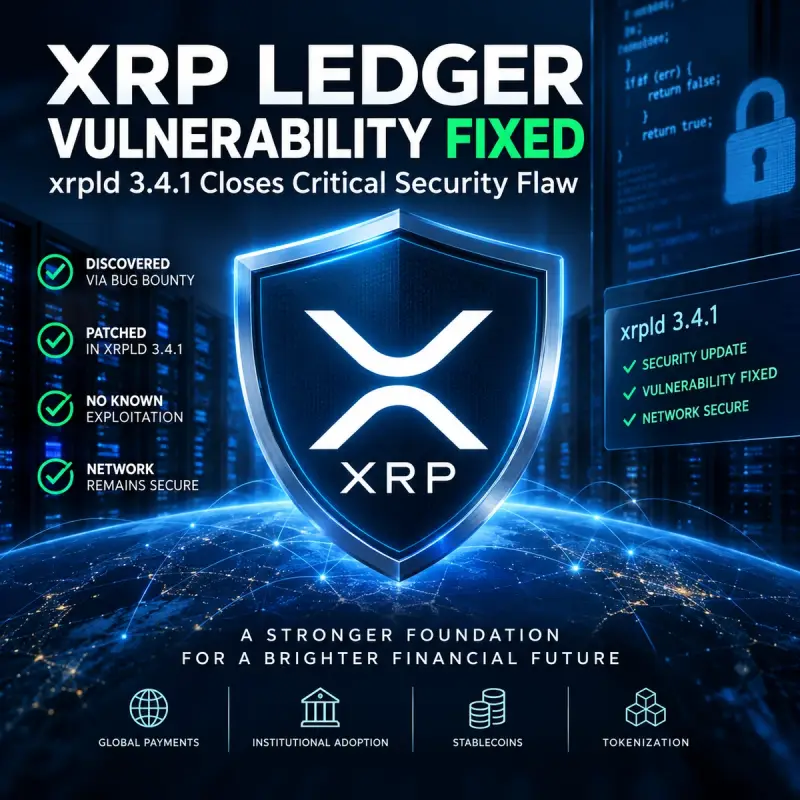
A critical vulnerability in the XRP Ledger has been disclosed after remaining undetected for years. Under specific conditions, the flaw could theoretically have allowed spendable XRP to be created without the sender being properly charged.
The vulnerability was reported through the XRPL bug bounty program on September 22, 2026. Developers were able to reproduce the issue in an isolated test environment.
The flaw was fixed with the emergency release xrpld 3.4.1, published on September 25.
Most importantly:
According to XRP Ledger developers, there is no evidence that the vulnerability was exploited on a public network.
How Did the Vulnerability Work?
The vulnerability affected a specific transaction flow within the XRP Ledger’s payment system.
Under certain technical conditions, a transaction could be processed in a way that allowed a recipient to receive XRP without the corresponding amount being properly deducted from the sender.
In simplified terms, this could theoretically have resulted in spendable XRP being created without an equivalent balance being removed elsewhere.
That would be a serious issue because the integrity of a blockchain depends on the network enforcing its monetary rules correctly.
For that reason, the flaw was treated as a high-priority security issue once it had been identified.
Why Was the Flaw So Critical?
The vulnerability was especially serious because it could theoretically have affected the total amount of spendable XRP.
The XRP Ledger is designed around a fixed supply model. New XRP are not normally created through everyday network activity.
If a software flaw could allow XRP to appear without the sender being properly charged, that would undermine one of the network’s most fundamental rules.
That is why the issue was treated with high priority and addressed through an emergency software update.
For users, the most important point remains:
There is currently no evidence that the vulnerability was actually exploited on the public XRP Ledger.
The incident nevertheless highlights the importance of continuous security testing, bug bounty programs and rapid software updates for maintaining the integrity of a blockchain network.
How Was the Vulnerability Discovered?
The vulnerability was reported through the XRP Ledger bug bounty program.
Programs like this are designed to encourage independent security researchers to report potential weaknesses responsibly before they become public or can be exploited.
After the report was submitted, developers reproduced the issue in an isolated test environment and analyzed the technical cause.
A patched version was then released with xrpld 3.4.1.
The full technical details were not disclosed immediately. The priority was first to ensure that validators and other infrastructure operators had enough time to upgrade to the corrected version.
This approach reduces the risk of attackers using public technical information while unpatched systems are still active.

Why xrpld 3.4.1 Was So Important
The vulnerability was fixed with xrpld 3.4.1.
For a broader overview of the release, see our XRP Ledger 3.4.1 Security Update.
For validators and other XRP Ledger infrastructure operators, upgrading to the patched version was therefore especially important. The faster a large share of the network moved to the corrected software, the lower the potential risk became.
Developers first released the security update and withheld some technical details until enough operators had upgraded.
This was intended to reduce the chance that attackers could use the public description of the flaw while vulnerable systems were still running.
The incident also shows that XRP Ledger software updates are not only about adding new features. They can also contain critical security fixes that are important for the stability and integrity of the entire network.
What Does the Incident Mean for XRP Holders?
For XRP holders, it is important to distinguish between a theoretical technical risk and an actual loss.
According to the information published so far, there is no evidence that the vulnerability was exploited on the public XRP Ledger.
That means:
- there are no known cases of XRP being created through this flaw
- there are no known cases of XRP being stolen through this specific vulnerability
- the issue has already been fixed with xrpld 3.4.1
The incident is still important because it shows that even established blockchain networks can contain software bugs.
What matters is how quickly those weaknesses are discovered, reported and corrected.
In this case, the flaw was reported through the bug bounty program, reproduced by developers and then closed with a security update.
What Does This Mean for XRP Ledger Security?
The incident is serious, but it should not automatically be interpreted as proof that the XRP Ledger is fundamentally insecure.
What matters is how the network responds when critical weaknesses are discovered.
In this case, the vulnerability was identified through a bug bounty program, reproduced in a controlled environment and fixed with xrpld 3.4.1. Technical details were disclosed only after enough infrastructure operators had time to upgrade.
That is a standard approach for handling sensitive security issues.
For the XRP Ledger, the incident therefore also serves as a test of its security processes: vulnerabilities can occur, but they need to be identified quickly, fixed in a coordinated way and documented transparently.
This becomes even more important as the XRP Ledger expands into institutional applications, stablecoins and tokenized assets. The more financial value moves across the network, the higher the requirements for security, reliability and operational resilience.
For a broader overview of how security, tokenization, stablecoins and institutional applications fit into the XRP Ledger’s development in 2026, see our XRP Ledger Institutional Finance Map 2026.
At the same time, new features such as Permission Delegation are pushing the XRP Ledger further toward institutional use.
Connection to Institutional Use Cases and Stablecoins
The timing of the security fix is also relevant because the XRP Ledger is increasingly being developed for institutional financial applications.
These include:
- stablecoins
- tokenized assets
- institutional payments
- digital financial products
- automated financial applications
As the economic importance of these use cases grows, a resilient and secure technical foundation becomes increasingly important.
RLUSD, Ripple’s U.S. dollar-backed stablecoin, can also be used on the XRP Ledger. This means that network security is relevant not only for traditional XRP transactions, but potentially also for stablecoin and tokenized asset applications.
The incident therefore highlights two sides of the same development: even mature systems can contain critical software flaws, but strong security research, rapid updates and coordinated network maintenance are essential as the XRP Ledger moves further into institutional finance.
Ripple’s recent cooperation with Meritz Securities in South Korea also shows how strongly institutional financial infrastructure is becoming part of the broader ecosystem.
Verlinke nur cooperation with Meritz Securities in South Korea.
Learn More About XRP, Ripple and the Future of Digital Finance
If you want to understand the bigger picture behind XRP, Ripple, the XRP Ledger, RLUSD, stablecoins, tokenization and institutional adoption, my book “XRP – WHEN THE GIANT AWAKENS” provides a much deeper overview.
The book explains not only the XRP ecosystem, but also the foundations of today’s financial system — from banks, money creation and inflation to blockchain, digital assets and the possible future of international financial infrastructure.
Place the book promotional video here.
Directly below the video, place the English book cover.
XRP – WHEN THE GIANT AWAKENS
Ripple, XRP and the Trillion-Dollar Opportunity in Digital Finance
by Adrian Caldor

Conclusion
The XRP Ledger vulnerability was serious, but according to the information published so far, it was discovered and fixed before there was any known exploitation on the public network.
For XRP holders, the key point is that there is currently no evidence that the flaw was used to create or steal XRP.
The incident nevertheless shows that even established blockchain networks require continuous security testing and maintenance.
What matters most is not whether software bugs can exist, but how quickly they are discovered, reported and fixed.
As the XRP Ledger becomes increasingly relevant for institutional applications, stablecoins and tokenized assets, network security will become even more important.
For XRP, this does not automatically create a direct price impact. But for the long-term development of the XRP Ledger, a strong and reliable security process is essential.
Sources
-
XRPL.org – Vulnerability Disclosure Report for xrpld 3.4.1
Open source -
XRPL.org – Introducing XRP Ledger version 3.4.1
Open source -
CoinDesk – October 10, 2026
XRP Ledger patched decade-old bug that could create billions of dollars in XRP from nothing
Open source
Add comment
Comments