

Ripple is further expanding its presence in the global financial industry. On October 14, 2026, the blockchain company announced a strategic partnership with US financial services provider DriveWealth. At the heart of the collaboration is the planned integration of the RLUSD stablecoin on the XRP Ledger (XRPL) into the international infrastructure for stock trading and securities settlement.
The partnership also includes cross-border payments, digital asset custody and potential institutional financing solutions.
Of particular significance is DriveWealth's global reach. The company provides brokerage infrastructure to more than 100 international partners, including financial institutions and fintech platforms.
This collaboration could open the door for Ripple's blockchain technology to become part of another important segment of traditional capital markets.
A New Bridge Between Stock Markets and Blockchain Technology
International stock trading has become increasingly digitalised. Investors can buy and sell securities within seconds through modern financial platforms. However, the transfer and availability of the funds required for these transactions still frequently depend on traditional banking systems.
This is precisely where the collaboration between Ripple and DriveWealth comes into play.
While US stock transactions are generally settled within one business day under the so-called T+1 settlement cycle, international bank transfers can take considerably longer. As a result, financial institutions often need to hold substantial amounts of capital in advance to ensure sufficient liquidity.
The integration of RLUSD on the XRP Ledger aims to make these processes more efficient.
By using blockchain-based stablecoin infrastructure, funds could potentially move more quickly between financial systems and become available for securities transactions with fewer delays.
This could offer significant advantages for internationally operating banks, brokers and fintech companies, particularly in terms of liquidity management and capital efficiency.
RLUSD on the XRP Ledger: A Major Step for Institutional Financial Transactions
At the centre of the new partnership is Ripple's US dollar-backed stablecoin RLUSD, which was launched in December 2024.
DriveWealth plans to use RLUSD on the XRP Ledger for institutional settlement processes. The integration is expected to begin in Europe before expanding to the United States.
One of the main objectives is to enable financial institutions to fund their collateral accounts using stablecoins and convert these digital assets into traditional cash balances in near real time when needed.
The XRP Ledger provides a technical infrastructure designed for fast transactions, low fees and energy-efficient operations.
Security is another important factor for institutional adoption. The XRP Ledger's recent critical security fix demonstrates why regular software updates and reliable network infrastructure are essential as financial institutions increasingly explore blockchain-based settlement systems.
What makes this development particularly significant is the explicit use of RLUSD on the XRP Ledger. This could introduce another institutional use case for the blockchain within traditional financial markets.
The integration also comes at a time when Ripple's stablecoin is gaining momentum. As previously reported by KryptoKompass, RLUSD has approached $2.5 billion in circulating supply, highlighting its growing role in digital finance.
However, using RLUSD does not automatically mean that DriveWealth will use XRP as a bridge currency. XRP remains the native digital asset of the network and is required, among other things, to pay transaction fees.
Whether the partnership will ultimately generate substantial additional demand for XRP will depend on actual adoption, transaction volumes and the financial services introduced in the future.
Ripple Payments, Ripple Custody and Ripple Prime Expand the Partnership
The partnership between Ripple and DriveWealth extends far beyond the planned use of the RLUSD stablecoin. Both companies aim to connect several areas of their financial infrastructure, creating new opportunities for institutional clients.
One important component is Ripple Payments. The payment solution is expected to help DriveWealth process cross-border money transfers for its international business partners more quickly and efficiently.
In addition, the integration of Ripple Custody is planned. This technology enables financial institutions to securely store and manage digital assets. The initial focus will be on Europe, with potential expansion into additional markets at a later stage.
Ripple Prime also plays a role in the collaboration. Both companies are exploring additional financing opportunities in institutional equity markets, particularly within the so-called Delta One segment.
Ripple's expansion into traditional capital markets has already gained momentum through Ripple Prime, which is increasingly involved in institutional brokerage and ETF financing. This development illustrates how Ripple is extending its reach into financial services traditionally dominated by major Wall Street institutions.
Through this partnership, Ripple is pursuing a comprehensive approach that brings together payments, stablecoins, digital asset custody and capital markets financing.
For DriveWealth, this could create a more flexible financial infrastructure over time, while Ripple continues to strengthen its position as a technology provider for the global financial industry.
More Than 100 International Partners: The Potential for the XRP Ledger
One of the most interesting aspects of the collaboration is DriveWealth's international reach. The US-based company provides brokerage technology to more than 100 partners worldwide, including fintech companies and digital financial platforms.
Through this infrastructure, investors gain access to international capital markets, particularly US stock trading.
The planned integration of Ripple's technologies could allow the XRP Ledger to play a role in an established financial ecosystem where substantial amounts of capital are transferred and managed.
For Ripple, this creates an opportunity to introduce its blockchain infrastructure to a broader range of financial institutions through existing business relationships.
However, an important distinction must be made: The partnership does not mean that all DriveWealth partners will automatically adopt RLUSD or the XRP Ledger. Actual adoption will depend on technical implementation, regulatory requirements and individual business decisions.
Nevertheless, the collaboration highlights the potential of blockchain technology when it is integrated directly into existing financial infrastructure rather than being limited to cryptocurrency trading platforms and blockchain-native projects.
Ripple Is Becoming a Comprehensive Infrastructure Partner for the Financial Industry
The collaboration with DriveWealth demonstrates how significantly Ripple has expanded its business strategy in recent years. While the company originally became known primarily for its international payment solutions, its portfolio now covers several important areas of institutional finance.
With Ripple Payments, the company provides solutions for cross-border money transfers. Ripple Custody serves financial institutions seeking secure storage and management of digital assets. Ripple Prime expands the offering with services for institutional market participants, while the RLUSD stablecoin is designed to connect traditional currencies with blockchain-based financial applications.
The XRP Ledger serves as an important technological foundation for certain applications within this ecosystem.
What makes this development particularly noteworthy is the increasing integration of these different services. Ripple is no longer focusing solely on individual challenges in international payments. Instead, the company is working to connect multiple areas of the global financial system.
The partnership with DriveWealth provides a concrete example of this strategy. If the planned integration is successfully implemented, blockchain-based payments, stablecoin settlements and institutional financial services could become more closely interconnected.
This development also fits into the broader institutional direction of the XRP Ledger, which was highlighted at XRP Seoul 2026, where privacy, AI-powered applications and next-generation financial infrastructure were among the central topics.
This positions Ripple increasingly as a financial infrastructure provider operating at the intersection of traditional finance and digital assets.
What Does the Partnership Mean for XRP and RLUSD in the Long Term?
The partnership between Ripple and DriveWealth could have long-term implications for both the RLUSD stablecoin and the broader XRP Ledger ecosystem.
One of the most important aspects is the planned integration of RLUSD into an established international financial infrastructure. If DriveWealth successfully launches the announced services and attracts additional business partners, institutional adoption of the stablecoin could increase significantly.
RLUSD's rapid growth in 2026 provides further context for this partnership. By late September, the stablecoin had approached $2.5 billion in circulating supply, reflecting its increasing presence in the digital asset market.
For the XRP Ledger, this development could also be important. Every additional application strengthens the network's practical relevance and demonstrates that its technology can support financial services beyond traditional cryptocurrency trading.
However, it is essential to distinguish between the adoption of the XRP Ledger and direct demand for XRP. Although XRP is required to pay transaction fees on the network, these fees are extremely low. Therefore, an increase in RLUSD transactions does not necessarily translate into a substantial increase in demand for XRP.
Further economic effects could emerge if financial institutions eventually decide to use XRP for liquidity management or as a bridge currency. However, such use has not been confirmed as part of the DriveWealth partnership.
The key factors will be actual transaction volumes, the number of active institutional users and the successful implementation of the planned services.
For now, the announcement should primarily be viewed as another step towards institutional adoption of the XRP Ledger rather than a guarantee of any particular future XRP price movement.
From Announcement to Implementation: What Remains Uncertain?
Despite the promising partnership between Ripple and DriveWealth, several important aspects of the collaboration are still in the implementation phase.
So far, no binding date has been announced for the full launch of all planned services. Specific figures regarding expected transaction volumes, the number of future RLUSD users and potential effects on XRP Ledger liquidity have also not been disclosed.
Regulatory requirements will play an important role in the next stages of development. Particularly in international securities trading, new payment technologies must comply with different national regulations and integrate smoothly with existing financial systems.
Furthermore, the technical ability to transfer stablecoins in near real time does not automatically mean that all subsequent banking and securities settlement processes can be completed at the same speed.
The next important milestones will therefore be the actual launch of DriveWealth's planned services and the adoption of these solutions by institutional business partners.
Only once these systems are operational and generating measurable transaction volumes will it be possible to assess the partnership's economic impact on RLUSD, the XRP Ledger and potentially XRP
XRP – When the Giant Awakens: Understanding the Future of Global Finance
The partnership between Ripple and DriveWealth demonstrates how traditional financial markets and blockchain technology are becoming increasingly interconnected.
But what role could Ripple, XRP, the XRP Ledger and stablecoins play in the future of the global financial system? And why are more banks, financial institutions and institutional investors exploring these technologies?
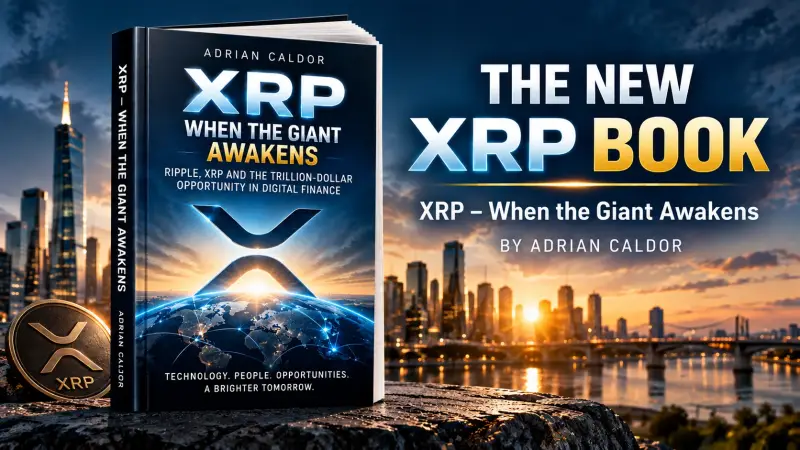
These questions, along with many others, are explored in the book “XRP – WHEN THE GIANT AWAKENS” by Adrian Caldor.
Spanning more than 500 pages, the book examines the foundations of today's monetary system, the evolution of blockchain technology and the potential impact of Ripple and XRP on international finance.
Alongside technological explanations and institutional developments, it explores possible future scenarios, opportunities and risks associated with the transformation of the global financial system.
Discover the XRP Book on Amazon
For readers who want to gain a deeper understanding of Ripple, XRP and the XRP Ledger, “XRP – WHEN THE GIANT AWAKENS” offers a comprehensive introduction and detailed insights into the potential future of the global financial system.
The book explores the relationship between traditional banking, blockchain technology, digital assets and institutional adoption, while examining both the opportunities and risks associated with this financial transformation.
Discover the book on Amazon and explore the future of Ripple, XRP and digital finance.
Conclusion: Ripple and DriveWealth Strengthen the Institutional Role of the XRP Ledger
The partnership between Ripple and DriveWealth represents another significant step towards integrating blockchain technology into traditional financial markets.
Of particular importance is the planned use of RLUSD on the XRP Ledger within an established international securities infrastructure. This could enable blockchain technology to play a greater role in liquidity management and institutional financial settlements.
DriveWealth's global network of more than 100 partners creates additional opportunities. If the integration proves successful, more financial institutions could gain access to Ripple's technologies and the XRP Ledger through existing business relationships.
For XRP investors, the long-term implications are particularly interesting. Although the partnership does not automatically generate substantial additional demand for XRP, successful institutional applications could strengthen the network's relevance within the global financial system.
However, several important milestones remain ahead. The actual launch of the announced services, institutional adoption and measurable transaction volumes will ultimately determine the economic significance of this collaboration.
The partnership demonstrates that Ripple is working to establish blockchain technology not merely as an alternative to traditional finance, but as an integral component of its future infrastructure.
Sources and Further Information
Ripple – Official Press Release, October 14, 2026
DriveWealth and Ripple Partner to Bring Institutional Digital Asset Infrastructure to Global Investing
The Block – October 14, 2026
DriveWealth to Use Ripple's RLUSD for Stablecoin Settlement and Cross-Border Payments
XRP Ledger – Official Website
Ripple USD (RLUSD) – Official Information
https://ripple.com/solutions/stablecoin/
Disclaimer: This article is for informational purposes only and does not constitute financial, investment, legal or tax advice. Cryptocurrencies and digital assets involve significant risks.
Add comment
Comments